Beginning
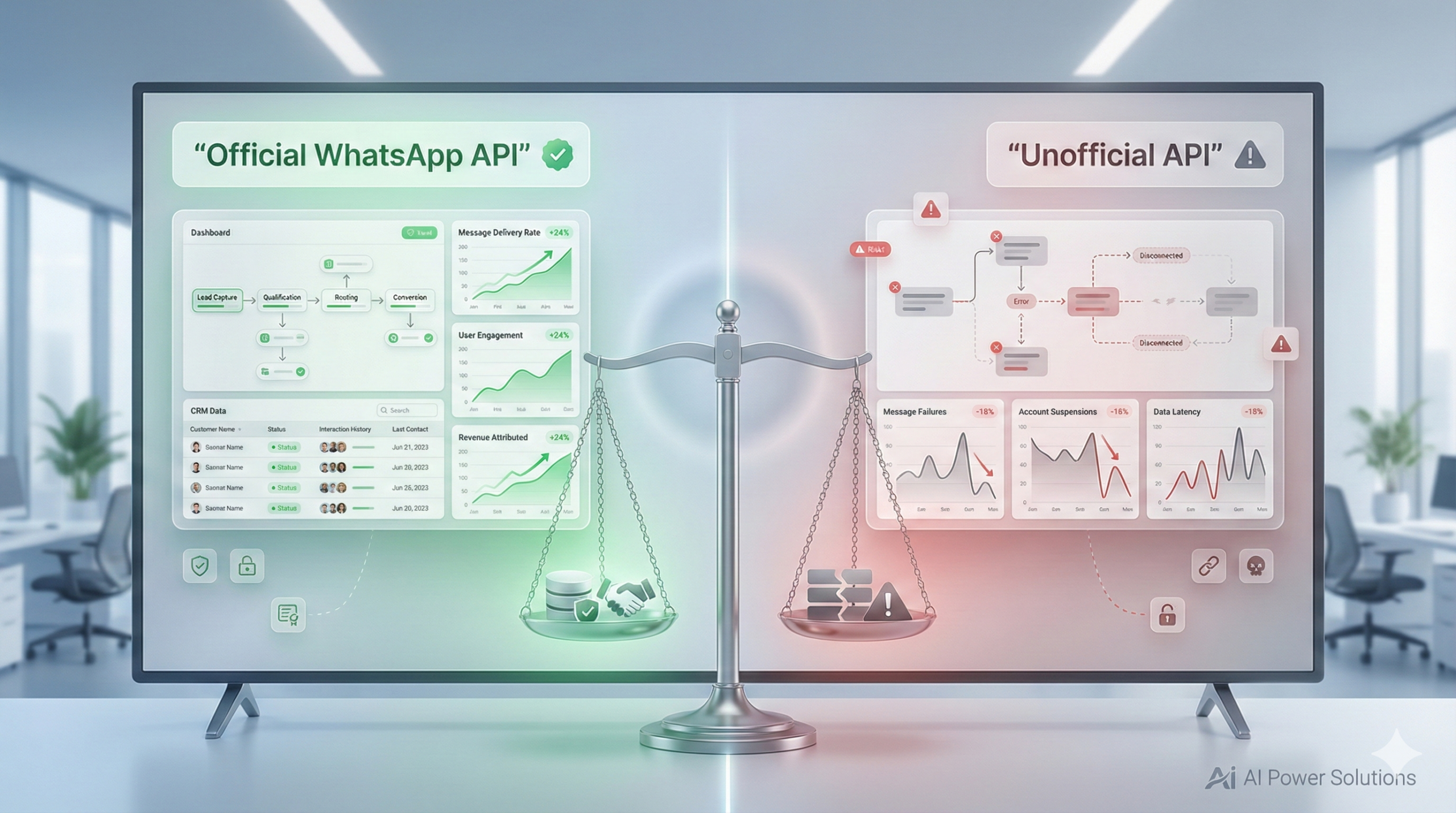
People often boil down the debate over the Official vs. Unofficial WhatsApp API to cost and flexibility. In reality, the choice affects automation, compliance, scalability, and operational continuity.
Many companies use unofficial integrations because they are easy to set up. Others invest in official infrastructure to ensure long-term stability. As message volume increases and automation becomes deeper, the difference between these two approaches becomes more significant.
Before adding WhatsApp to your communication system, you need to understand not only how each option works, but also how each one reacts under growth pressure.
AIPowerSolutions.in helps companies set up structured WhatsApp API systems designed for automation, CRM integration, and sustainable growth.
Getting to Know the Official WhatsApp API
The WhatsApp Business API is the official solution approved by Meta for business messaging. It is not a mobile application installed on a phone. It is cloud-based infrastructure designed to integrate with business systems.
This API enables structured messaging using approved templates, controlled automation workflows, CRM synchronization, chatbot deployment, and multi-agent access. Every outbound message follows Meta’s policies, which protect both users and businesses.
The official infrastructure is intended for businesses that use WhatsApp as a strategic communication tool rather than just a chat application.
It was built for predictability.
Learning About Unofficial WhatsApp APIs
Unofficial APIs are third-party integrations that simulate WhatsApp Web sessions. Instead of operating through Meta’s approved cloud infrastructure, they authenticate via QR code scanning and function like a browser-based session.
Because these systems are not officially approved, they typically allow outbound messaging without requiring prior template approval. Their flexibility makes them appealing to startups or businesses seeking rapid deployment.
However, flexibility does not equal stability.
Session-based authentication can be disrupted. High-volume outbound campaigns may trigger automated monitoring systems. Unlike official infrastructure, there is no direct Meta escalation channel when restrictions occur.
The operational model is fundamentally different.
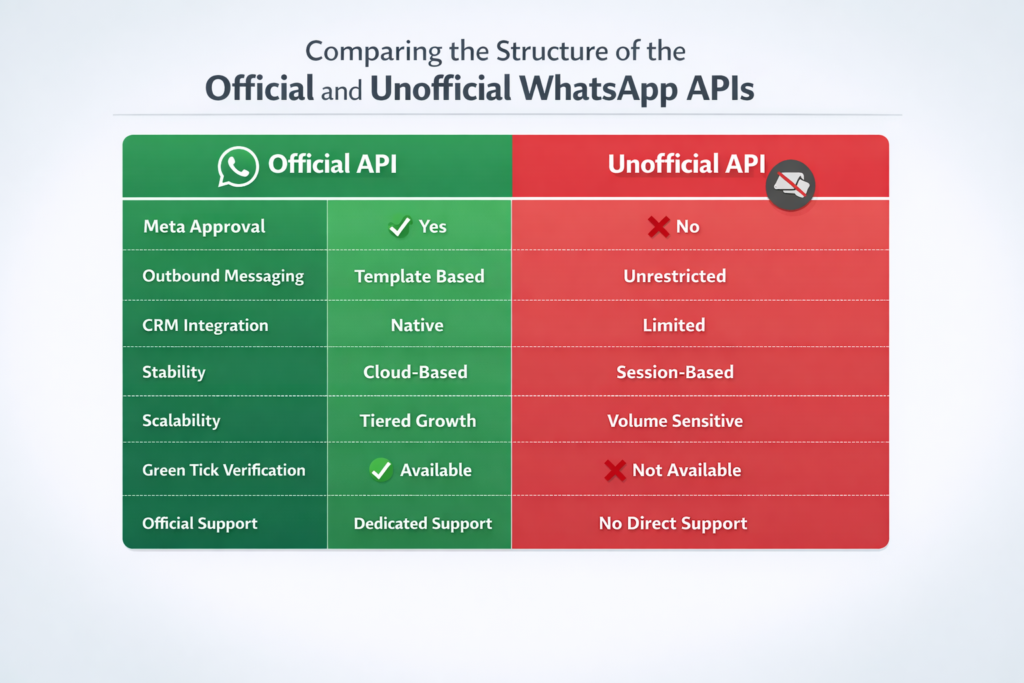
Comparing the Structure of the Official and Unofficial WhatsApp APIs
Below is a high-level structural comparison that highlights the primary operational differences:
| Capability | Official API | Unofficial API |
|---|---|---|
| Meta Approval | Yes | No |
| Template-Based Outbound | Required | Not Required |
| Compliance Monitoring | Structured | Reactive |
| CRM Integration | Native | Limited |
| Messaging Stability | Cloud Infrastructure | Session-Based |
| Scalability | Tier-Based Expansion | Volume-Sensitive |
| Green Tick Eligibility | Available | Not Available |
| Official Support | Yes | No |
The main difference lies in infrastructure control and compliance alignment.
Risk Exposure and Compliance
Meta continuously monitors user engagement, complaint rates, and spam behavior within its messaging ecosystem. Official accounts operate within defined categories such as marketing, utility, and authentication messaging. Template approval ensures communication quality is reviewed before large-scale distribution.
When users respond, a 24-hour conversation window opens. During this session, businesses can communicate freely. Outside that window, the template structure resumes. This design protects user experience and maintains platform trust.
Unofficial systems do not operate within this structured framework. While this may allow immediate outbound communication, it increases exposure to complaint-based restrictions. If complaint thresholds are exceeded, messaging capacity may be limited or suspended.
For businesses that rely on WhatsApp for customer service or revenue generation, this distinction is critical.
Infrastructure stability directly affects revenue continuity.
Automation Depth and System Design
Automation is where the operational gap becomes clearer.
The official infrastructure supports workflow-based communication. A lead can submit a website form, trigger a CRM entry, receive a template message, be routed to a chatbot for qualification, and then be assigned to a sales representative. Every step is measurable.
Unofficial systems may support automation to some extent, but integration depth is often limited. As automation volume increases, the likelihood of triggering platform monitoring also rises.
As automation becomes more advanced, infrastructure reliability becomes essential.
Businesses planning AI-based qualification, predictive engagement, or large-scale transactional messaging require structured systems rather than session-based simulations.
Other Cost Factors Beyond Pricing
Official infrastructure uses conversation-based pricing. Charges vary depending on whether the message falls under marketing, utility, or authentication. Each conversation opens a defined billing window.
At first glance, unofficial integrations may appear more cost-effective because they often charge a flat monthly fee.
However, cost analysis must include operational risk. Temporary suspension, forced migration, or account loss can disrupt revenue and damage customer trust. Hidden costs emerge when infrastructure instability interrupts core communication channels.
True cost analysis includes continuity risk.
Scalability Under Growth Pressure
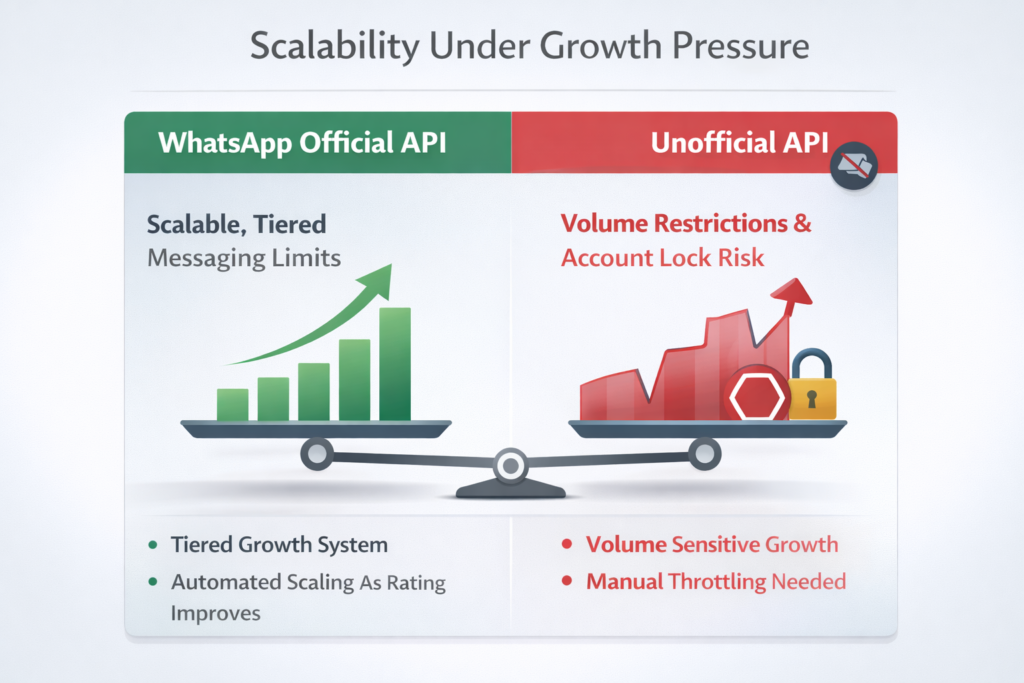
Official accounts operate within messaging tiers. As quality ratings improve and engagement remains positive, daily messaging capacity increases automatically. Scaling is structured and performance-driven.
Unofficial systems do not operate within Meta’s tier-based growth framework. Message volume spikes may increase monitoring exposure. Growth may need to be carefully throttled to avoid detection triggers.
If your business plans to expand campaign volume, launch automation sequences, or grow into new markets, infrastructure scalability must be evaluated before deployment.
Growth exposes system weaknesses.
When the Official Infrastructure Is the Strategic Choice
The official approach becomes essential when WhatsApp is positioned as a primary communication channel rather than a testing tool.
It is particularly suitable when:
- Your funnel depends on automation workflows
- CRM synchronization is required
- Multi-agent collaboration is necessary
- Brand credibility and verification are important
- Long-term scaling is planned
For structured businesses, stability outweighs short-term flexibility.
When Companies Experiment with Unofficial Systems
Unofficial integrations are often used during early experimentation phases. Startups with low message volume may use them to test workflows before committing to enterprise infrastructure.
However, as message volume increases, migration often becomes necessary. Migration requires template approval, business verification, and automation restructuring. Planning infrastructure early reduces transition friction.
Strategic planning prevents reactive migration.
Real-Life Scenario
Consider an online store sending 1,000 promotional messages daily through an unofficial system. Campaigns perform well initially. Over time, complaint rates increase. Message quality rating drops. Messaging capacity becomes restricted.
Communication stops during peak sales periods.
Under official infrastructure, the same store would:
- Submit marketing templates for approval
- Collect documented opt-in
- Gradually scale messaging volume
- Maintain quality rating
- Monitor engagement metrics
The difference is not messaging capability. It is operational control.
Why Companies Choose AIPowerSolutions.in
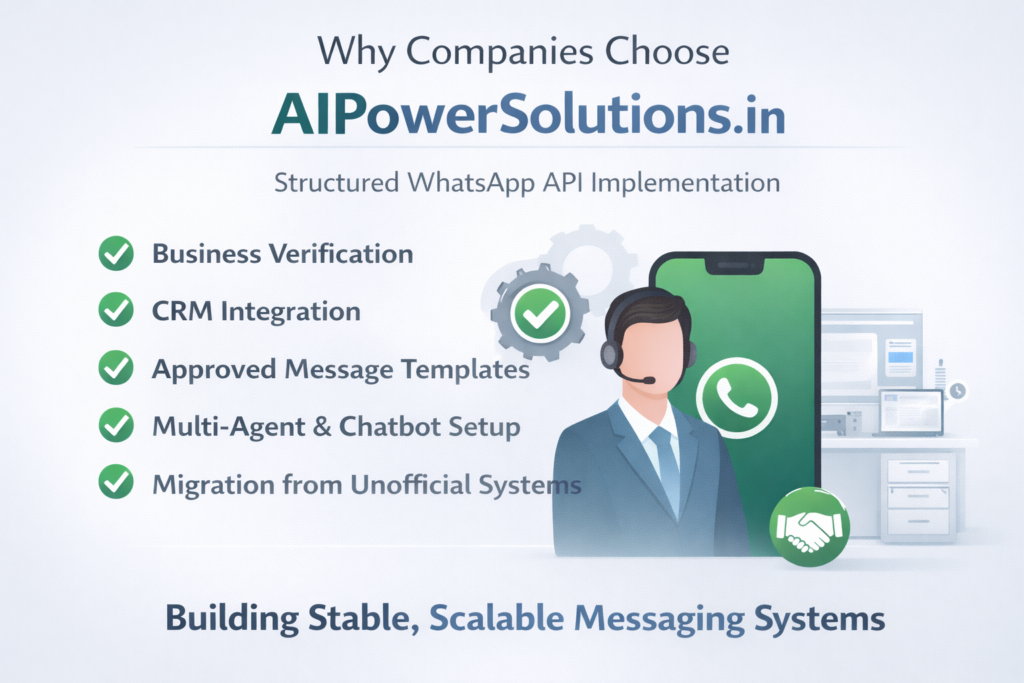
Implementing structured WhatsApp infrastructure requires more than API activation. It involves business verification, template approval, CRM integration, automation design, compliance monitoring, and performance optimization.
AIPowerSolutions.in provides complete deployment built for stability and scalability. The goal is not simply to enable communication, but to engineer a structured messaging system aligned with revenue objectives.
When infrastructure is implemented correctly, WhatsApp transitions from a support tool to a predictable growth channel.
Final Thoughts
Choosing between the Official and Unofficial WhatsApp API determines how your communication system performs under scale, automation, and compliance scrutiny.
Unofficial integrations may offer flexibility during early experimentation. However, they introduce infrastructure risk as message volume increases.
Official infrastructure provides structured automation, compliance alignment, CRM integration, and scalable capacity growth.
For businesses building long-term systems rather than short-term campaigns, infrastructure selection is a strategic decision.
AIPowerSolutions.in helps businesses implement compliant, scalable WhatsApp API systems designed for sustainable growth.
FAQ
What is the main difference between official and unofficial WhatsApp APIs?
The official API is Meta-approved and compliance-based. Unofficial APIs simulate WhatsApp Web and carry higher blocking risk.
Can unofficial APIs get banned?
Yes. High message volume or spam complaints can result in temporary or permanent restrictions.
Is the official WhatsApp API expensive?
Pricing is conversation-based. Costs vary by message category but provide stable infrastructure.
Can I send marketing messages using the official API?
Yes, but only through approved marketing templates and documented opt-in.
Is green tick verification possible with unofficial APIs?
No. Verification is available only through Meta-approved infrastructure.
Which option is better for scaling?
The official WhatsApp API is designed for structured scaling and automation.