Introduction: Customer Engagement Challenges in Digital Businesses
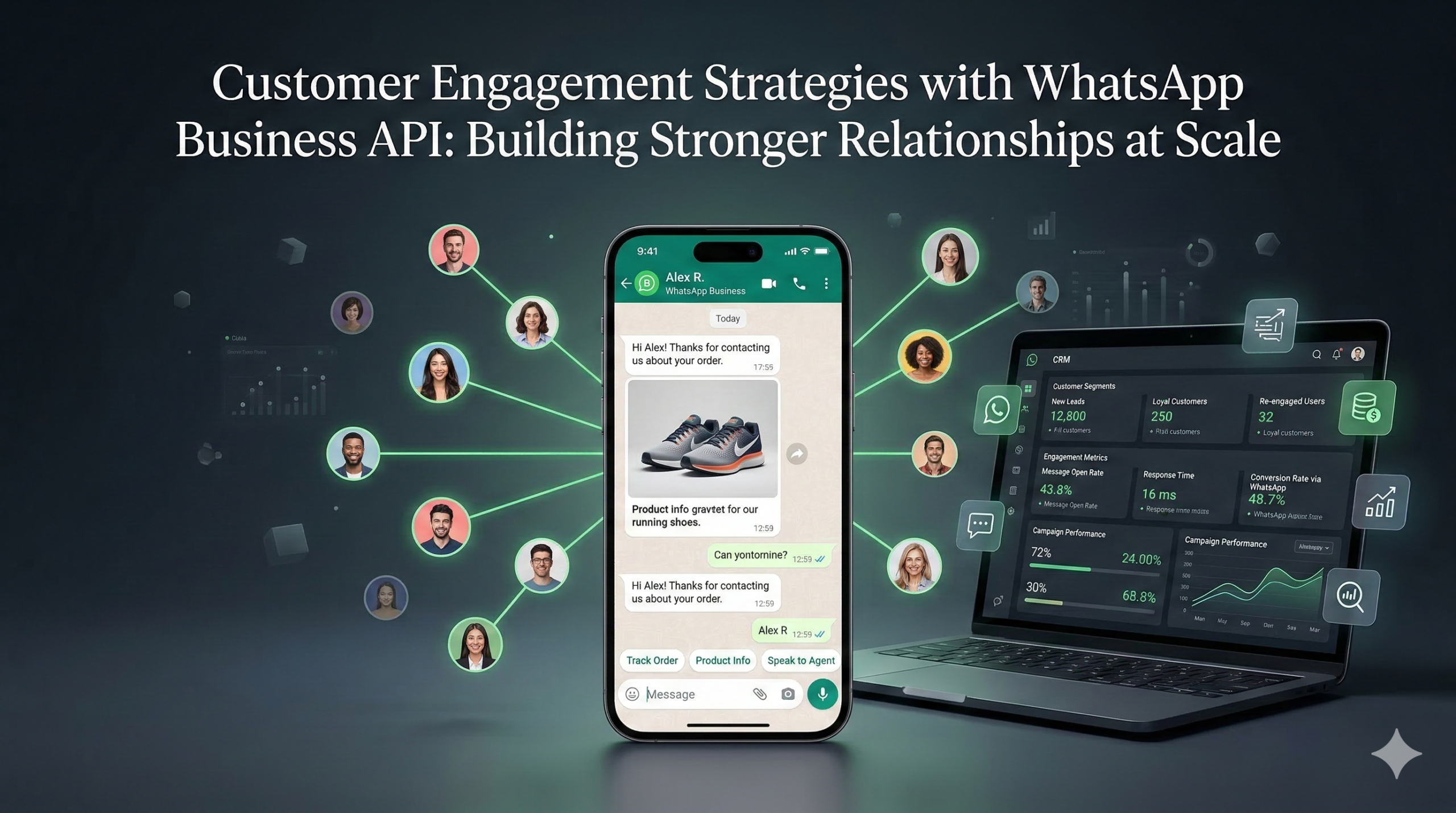
Customer acquisition costs continue rising, making engagement, retention, and lifetime value more critical than ever. Yet many digital businesses still rely on outdated channels like bulk email campaigns and generic SMS blasts. These approaches struggle in crowded inboxes and create shallow, transactional interactions rather than genuine relationships. Customers expect timely, relevant, contextual communication that fits their daily lives, not promotional noise.
WhatsApp Business API offers a solution through real-time, two-way conversations at scale. Integrated with CRM systems and automation platforms, businesses create personalized, high-frequency touchpoints that strengthen relationships over time. This conversational approach drives activation, retention, and expansion more effectively than traditional one-way broadcast channels.
Why Traditional Channels Are Losing Effectiveness
Email and SMS face fundamental limitations as primary engagement channels. Email open rates average 20-30% amid saturated inboxes, spam filters, and promotions tabs. Time-sensitive messages arrive too late, and customers rarely scroll through months of threads for context. SMS offers immediacy but restricts businesses to plain text with character limits. Links appear suspicious, and two-way interaction feels clunky.
Both channels lack conversational continuity. Interactions fragment across devices and platforms, forcing customers to restart conversations or hunt for previous messages. Engagement feels transactional rather than ongoing. WhatsApp solves these issues by combining immediacy, rich media support, and persistent conversation threads in customers’ most active daily channel.
How WhatsApp Improves Engagement with Real-Time Conversations
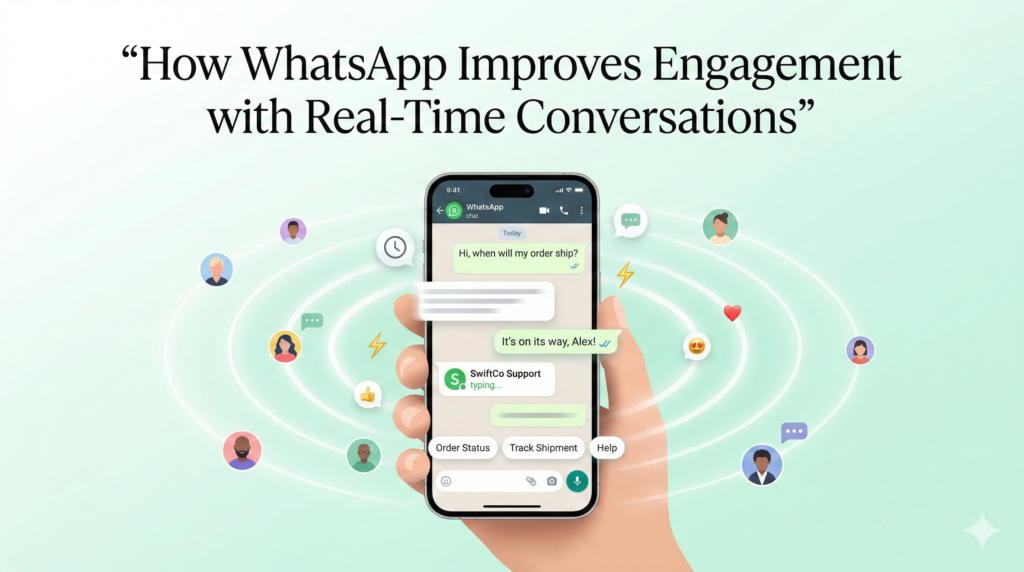
WhatsApp creates naturally engaging experiences through several key advantages. Customers receive real-time replies that build immediate trust. Conversations persist in single threads, letting users scroll back for context without digging through email archives. Rich media support clarifies complex information through images, videos, documents, and interactive buttons.
Mobile-first design matches how 80% of customers interact with brands—on smartphones during daily activities. End-to-end encryption reassures users sharing sensitive information like account details or purchase preferences. Interactive components guide decision-making through quick reply buttons and list menus, reducing cognitive load compared to static web pages.
Most importantly, WhatsApp conversations feel personal. Customers engage as they would with friends, creating stronger emotional connections than formal email exchanges. This conversational familiarity drives higher open rates, response rates, and sustained interaction over time.
Building Personalized Messaging Journeys Using WhatsApp
WhatsApp Business API powers multi-step engagement journeys that adapt to customer behavior. Onboarding sequences guide new users through key setup steps with contextual tips and support offers. Usage-based messaging responds to product activity—low usage triggers helpful nudges while high usage unlocks advanced feature tutorials.
Lifecycle journeys maintain relationships beyond transactions. Ecommerce customers receive care instructions, usage tips, and relevant product recommendations weeks after purchase. SaaS users get milestone celebrations, feature updates, and proactive support before issues arise. Each touchpoint builds toward retention and expansion rather than one-off sales.
These conversational journeys feel like dialogue rather than marketing blasts. Customers can interrupt, ask questions, or change direction anytime. Automation adapts responses based on replies, creating genuinely personalized experiences that traditional email sequences cannot match.
Using Segmentation and User Behavior for Targeted Communication
Effective WhatsApp engagement begins with smart segmentation. Businesses define meaningful customer groups based on lifecycle stage, product usage, purchase history, and expressed preferences. New customers receive onboarding support while power users get advanced feature unlocks. High-value accounts trigger priority engagement while at-risk customers receive proactive retention efforts.
Behavioral triggers make segmentation dynamic. Declining product usage prompts re-engagement flows with relevant resources. Recent purchases trigger care instructions and complementary product suggestions. Milestone achievements unlock personalized celebrations and expansion offers. These context-aware messages land precisely when customers need them most.
WhatsApp Business API integration with CRM platforms pulls rich customer data into conversation context. Account managers, plan tiers, and interaction history inform message personalization. This deep integration ensures WhatsApp conversations align perfectly with broader customer relationship strategies.
Automated Engagement Workflows: Welcome, Re-engagement, and Updates
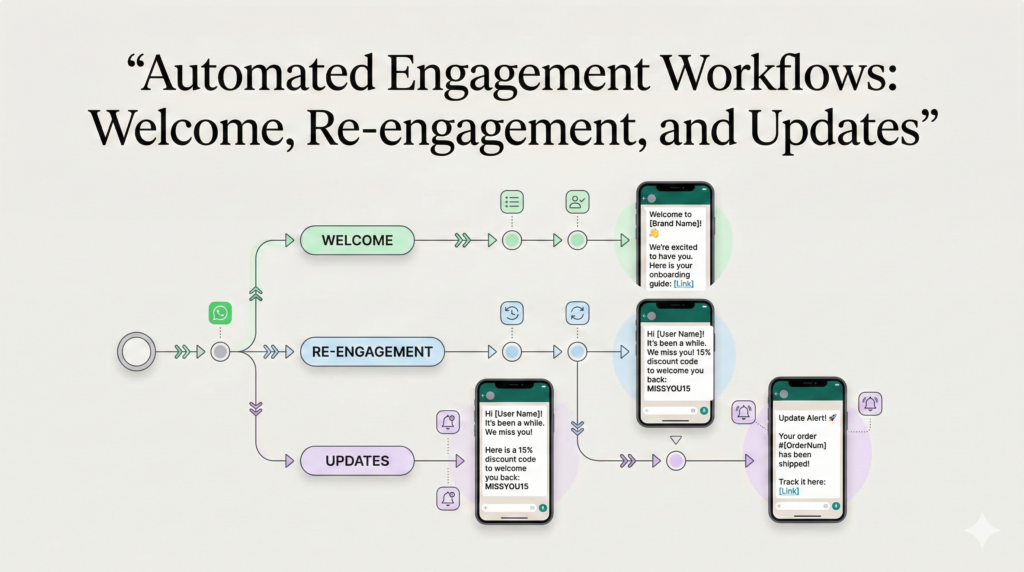
Automation scales engagement without overwhelming human teams. Welcome sequences activate immediately after signup or first purchase, highlighting 2-3 key success actions with direct support links. Onboarding nudges trigger when users stall, offering contextual help before frustration builds.
Re-engagement workflows revive dormant customers through friendly check-ins. “Notice you haven’t logged in recently—need help with anything?” prompts often restart conversations more effectively than generic promotional emails. Product update notifications highlight relevant improvements based on customer segment and usage patterns.
Event-driven workflows respond to account changes. Billing updates include clear explanations and support options. Plan renewals trigger value recaps and upgrade prompts. These automated touchpoints maintain relationships through relevant, timely communication across the entire customer lifecycle.
Using Rich Media for Better Interaction
WhatsApp’s rich media capabilities transform engagement quality. Images clarify product features, usage scenarios, and troubleshooting steps. Short videos demonstrate functionality or highlight new capabilities. Documents deliver detailed guides, invoices, or pricing breakdowns.
Interactive buttons and lists streamline decision-making. “Choose your plan,” “Book demo,” or “Contact support” options reduce typing while guiding users toward desired actions. Voice notes add personal warmth for high-touch interactions or complex explanations requiring nuance.
Rich media enhances comprehension and memory retention. Visual explanations stick better than text walls. Interactive elements reduce decision friction. However, businesses must balance richness with brevity—overloading conversations risks disengagement. Strategic media use amplifies engagement without overwhelming recipients.
Integrating WhatsApp with CRM for Personalized Engagement
CRM integration elevates WhatsApp from chat channel to strategic engagement platform. HubSpot contact timelines display WhatsApp conversations alongside email and call logs. Salesforce opportunity records link WhatsApp interactions with deal progression. Zoho customer profiles aggregate messaging data with purchase history and support tickets.
Dynamic personalization pulls CRM data into conversations. Account managers receive context about customer tenure, plan value, and recent activity. Segmentation rules trigger relevant messaging based on lifecycle stage or behavior patterns. Engagement workflows activate automatically when CRM conditions are met.
Cross-functional alignment emerges naturally. Marketing coordinates campaigns with sales account plans. Success teams reference support conversations during expansion discussions. Leadership gains complete visibility across engagement channels. WhatsApp becomes first-class infrastructure rather than isolated messaging.
Using Templates for Engagement Campaigns and Notifications
Pre-approved templates enable proactive communication beyond 24-hour windows. Onboarding follow-ups reinforce key actions. Feature announcements highlight relevant updates by segment. Win-back sequences re-engage lapsed customers with value-first messaging.
Template design principles emphasize clarity and utility. Concise subject lines communicate immediate value. Dynamic variables personalize content with names, account details, and context. Single clear calls-to-action focus recipient attention. Opt-out instructions maintain compliance.
Template lifecycle management ensures effectiveness. A/B testing compares performance across variants. Language localization supports global audiences. Regular Meta re-approval prevents content drift. Performance analytics guide optimization toward highest engagement rates.
Measuring Engagement Metrics in WhatsApp
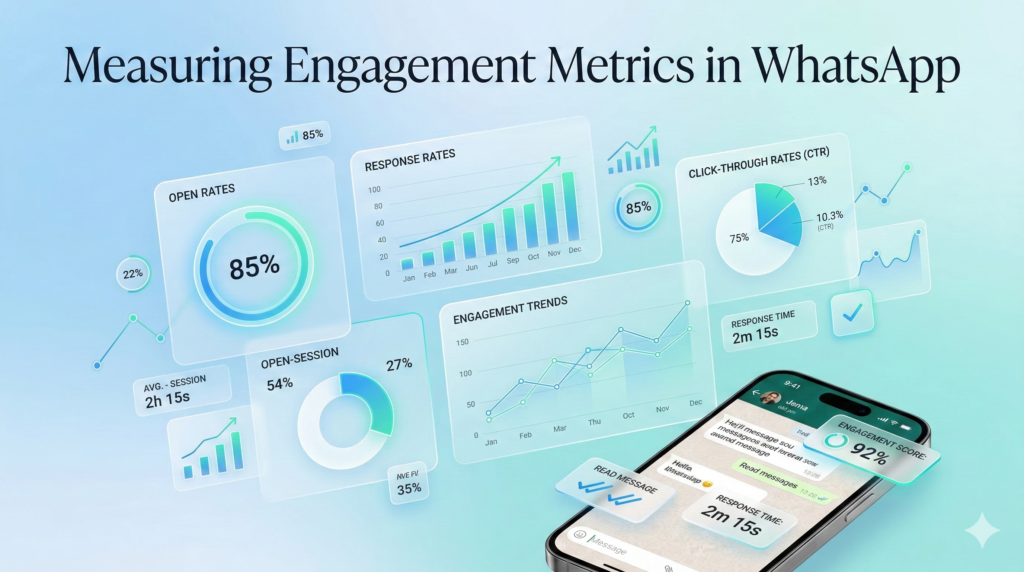
WhatsApp engagement analytics reveal workflow effectiveness. Delivery rates confirm infrastructure reliability. Read receipts measure content resonance. Response rates indicate conversational activation. Click-through rates track interactive element performance.
Time-to-response metrics benchmark automation speed. Conversation depth reveals engagement quality. Downstream metrics connect messaging to business outcomes—feature adoption, activation rates, retention improvements, and revenue expansion.
Comparative analysis benchmarks WhatsApp against email and SMS. Channel-specific optimization emerges from granular data. High-performing flows scale automatically. Underperforming patterns receive targeted improvements. Data-driven refinement creates continuous engagement improvement cycles.
Strategies to Increase Retention and Repeat Interactions
Retention strategies leverage WhatsApp’s conversational advantages. Value reinforcement messages highlight ROI through usage summaries and success metrics. Proactive support anticipates issues before customers experience frustration. Quick feedback loops gather actionable insights through 1-click surveys.
Expansion opportunities appear naturally through contextual recommendations. Feature unlocks celebrate milestones while suggesting relevant upgrades. Cross-sell suggestions align with demonstrated needs rather than generic promotions. Personalized offers respect purchase patterns and preferences.
Ongoing relationship nurturing maintains engagement beyond transactions. Seasonal check-ins acknowledge customer tenure. Industry insights position brands as trusted advisors. Community invitations foster belonging among high-engagement segments. These strategies convert customers into advocates.
Common Mistakes in WhatsApp Engagement Strategies
Over-messaging erodes goodwill. Excessive frequency overwhelms customers regardless of content quality. Frequency caps aligned with segment preferences prevent fatigue. Poor targeting wastes attention on irrelevant recipients. Behavioral segmentation ensures relevance before engagement begins.
Missing human fallback frustrates customers needing complex assistance. Every automated flow requires clear escalation paths to live agents. Context preservation during handoffs maintains conversation continuity. Over-automation without escape routes damages trust permanently.
Compliance violations threaten deliverability. Template misuse, opt-in neglect, and policy violations risk account restrictions. Governance frameworks prevent delivery failures. Regular compliance audits maintain sustainable infrastructure. Proactive monitoring catches issues before escalation.
Isolated channel management creates disjointed experiences. WhatsApp engagement disconnected from CRM and other channels produces contradictions. Unified orchestration across email, in-app, and messaging ensures cohesive communication. Cross-channel visibility reveals complete customer context.
Example: A Business Improving Engagement with WhatsApp Automation
A mid-size SaaS analytics platform struggled with onboarding and feature adoption. Email open rates declined steadily while early churn remained high. WhatsApp Business API implementation transformed engagement patterns dramatically.
New users opted into WhatsApp onboarding at signup. Automated sequences delivered 3 key setup steps with direct support links. Usage-based nudges triggered for stalled accounts. CSMs joined high-value conversations with complete context. Templates handled feature updates and win-back sequences.
Three-month results exceeded expectations. Onboarding completion rates doubled compared to email-only cohorts. Time-to-first-insight dropped 47%. Retention improved 23% among WhatsApp-engaged users. CSAT scores rose from 3.6 to 4.5. Feature adoption increased across engaged segments.
WhatsApp became the highest-signal engagement channel despite representing only 18% of total messaging volume. Contextual relevance drove disproportionate impact. Cross-functional teams gained unprecedented visibility into customer activation patterns and roadblocks.
Scaling Engagement Systems with WhatsApp Infrastructure
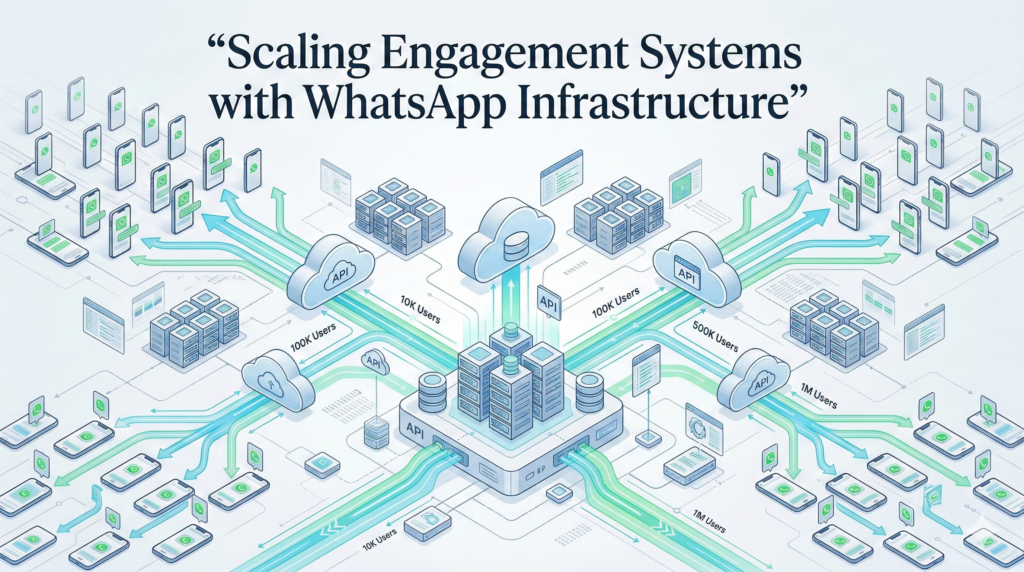
Infrastructure evolution supports sustained growth. Messaging tier progression enables 1K→100K daily conversations. Multi-number deployments distribute volume across regions and segments. Load balancing prevents single-point capacity constraints during peak campaigns.
Workflow standardization creates reusable engagement patterns. Modular templates support rapid localization. Centralized orchestration coordinates WhatsApp with email and in-app messaging. Unified customer profiles prevent cross-channel contradictions.
Governance frameworks ensure compliance at scale. Template approval pipelines streamline content deployment. Opt-in management prevents deliverability issues. Quality rating monitoring maintains green status across high volumes.
Continuous optimization leverages granular analytics. Engagement heatmaps reveal optimal timing patterns. A/B testing refines messaging variants. Segmentation refinement improves relevance continuously. Data-driven evolution maximizes lifetime value across customer cohorts.
Conclusion
WhatsApp Business API transforms customer engagement from sporadic broadcasts into continuous, conversational relationships. Real-time messaging, rich media support, and behavioral personalization create interactions customers genuinely value. CRM integration ensures alignment across marketing, success, and support functions.
Automation scales high-touch engagement without sacrificing relevance. Compliance frameworks sustain deliverability across massive volumes. Analytics reveal optimization opportunities continuously. Forward-thinking businesses treat WhatsApp as core infrastructure rather than supplemental channel.
FAQ
What makes WhatsApp Business API better for engagement than email?
WhatsApp delivers 98% open rates within minutes versus email’s 20-30% over hours. Persistent conversations maintain context. Rich media clarifies complex information instantly.
How does WhatsApp Business API integrate with CRM systems?
Conversations sync as timeline activities in HubSpot, Salesforce, and Zoho. Customer data pulls into WhatsApp for personalization. Workflows trigger across channels based on engagement patterns.
What compliance rules apply to WhatsApp engagement?
24-hour messaging windows permit free conversations. Templates require Meta approval beyond windows. Opt-in consent mandates explicit permission for promotional content.
Can WhatsApp engagement scale to enterprise volumes?
Messaging tiers support 1K-100K daily conversations. Multi-number deployments handle regional scale. Load balancing prevents capacity issues during peak campaigns.
How do businesses measure WhatsApp engagement success?
Track delivery/read rates, response rates, CTRs, conversation depth, and downstream metrics like activation, retention, and revenue impact compared to other channels.