Introduction: Modern Lead Generation Challenges
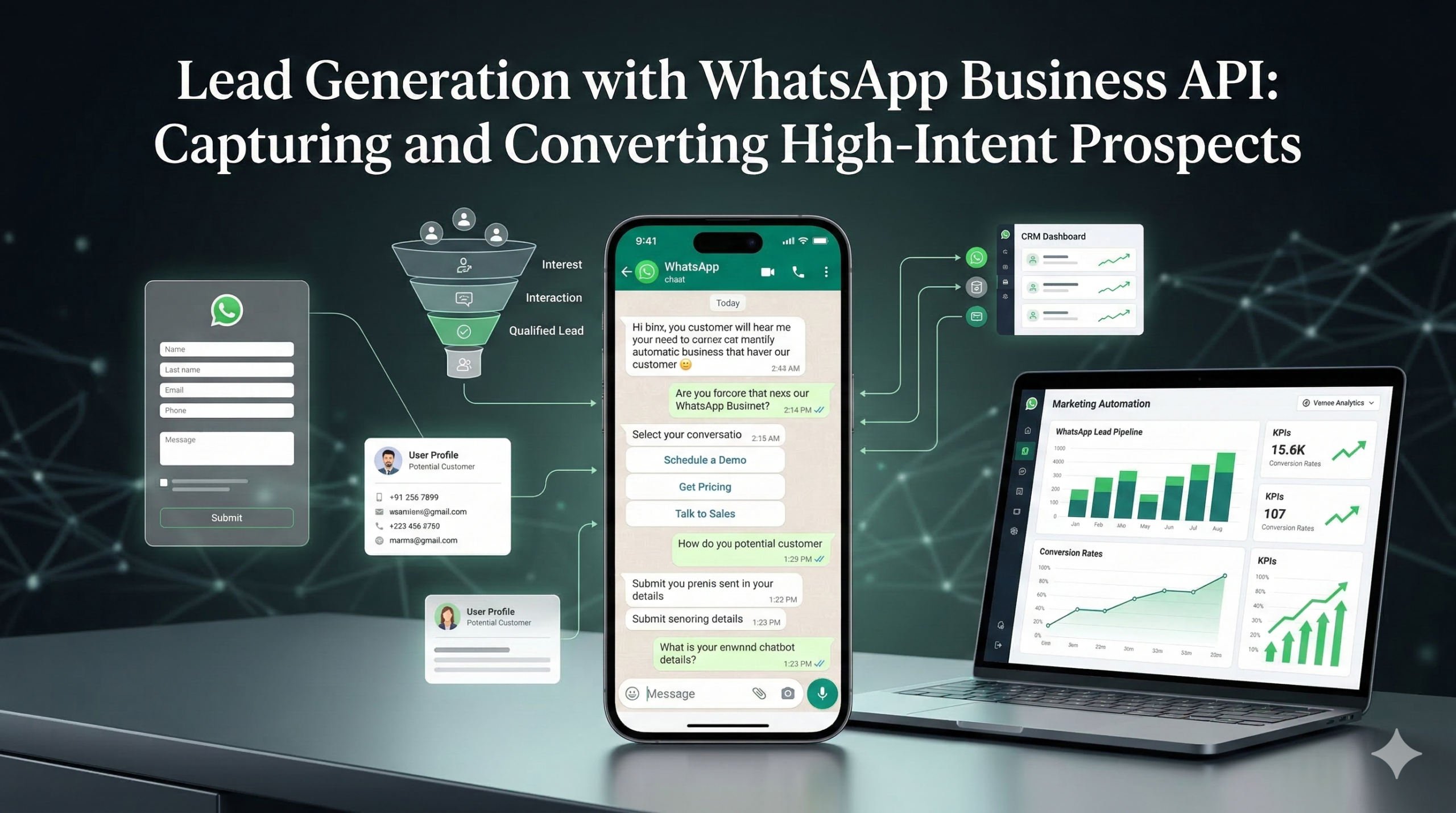
Digital lead generation is competitive, but WhatsApp Business API lead generation changes everything. Ads are expensive, forms have high abandonment, and email follow-ups get ignored. WhatsApp Business API lead generation moves prospects from click to qualified conversation instantly. Businesses capture leads through ads, websites, and QR codes, then qualify them with automation. This conversational approach delivers 3x higher conversion than traditional forms. AIPowerSolutions.in builds these WhatsApp Business API lead generation systems for global teams.
At the same time, buyers are becoming more impatient and more conversational. They want answers now, in channels they use daily. This is where WhatsApp Business API offers a powerful alternative. Instead of sending traffic into static pages and hoping people fill out forms, businesses can move prospects directly into WhatsApp conversations, where automation and human teams together can qualify and convert leads in real time.
For marketers, founders, and growth teams, treating WhatsApp as a first-class lead generation and conversion channel unlocks a new layer of responsiveness and personalization that traditional funnels struggle to match.
Why Traditional Forms and Email Funnels Underperform
Traditional lead capture relies heavily on web forms and email nurture sequences. This model has several inherent weaknesses:
First, forms introduce friction. Long fields, required inputs, and clunky mobile layouts discourage completion. Prospects often abandon halfway, especially on smaller screens or when on the move.
Second, email follow-up is slow and increasingly ignored. Even good email campaigns struggle to stand out in crowded inboxes. Open rates are modest, and replies are often delayed. By the time your team responds, the lead may have already spoken to a competitor or lost interest.
Third, the experience is one-way and non-conversational. Forms ask prospects to submit information and wait. Emails tell them what you want them to know, instead of letting them ask what they care about most. There is little room for real-time clarification, objections, or context.
These limitations are less about bad execution and more about the nature of the channels themselves. To improve lead generation outcomes, many companies are shifting from static, form-based funnels to conversational, messaging-first experiences.
How WhatsApp Business API Lead Generation Works
WhatsApp solves several bottlenecks in the traditional lead generation flow.
Because WhatsApp is already installed and actively used on billions of devices, there is almost no friction to start a conversation. Instead of filling out a form, a user taps a button and lands in a chat they already understand. Starting with a simple “Hi, I’m interested in your service” feels much easier than navigating multi-step forms.
Response speed improves dramatically when WhatsApp Business API is combined with automation. Incoming messages trigger instant replies—acknowledgments, basic answers, and guidance—within seconds. This matters, because multiple studies have shown that responding to leads within five minutes can dramatically increase conversion rates compared to slower follow-up.
WhatsApp also keeps the interaction alive. Conversations continue across time without expiring like sessions on a landing page. Prospects can return later, scroll up to review shared information, and pick up the thread exactly where they left off. This continuity helps build trust and keeps your brand in their everyday channel.
In short, WhatsApp makes lead capture more natural and reduces the time between interest and meaningful engagement, which is at the heart of better lead conversion.
Click-to-WhatsApp Ads and Landing Page Integrations
A key mechanism for driving WhatsApp-based leads is the use of Click-to-WhatsApp ads and tight landing page integrations.
Click-to-WhatsApp ads on platforms like Facebook and Instagram allow businesses to replace the traditional “Click → Landing Page → Form” path with “Click → WhatsApp Chat.” When a user taps the ad, the social platform opens a WhatsApp conversation with your business number, often with a pre-filled message such as “I’d like to know more about ” or “I’m interested in a demo.”
This approach converts ad clicks into conversations instead of passive visits. It is especially powerful for high-intent audiences—people who already have a question, need, or project in mind—because it lets them act immediately.
On your website, you can implement “Chat on WhatsApp” buttons or widgets on key pages: pricing, demos, product detail pages, or service descriptions. Instead of only offering a form, you give visitors the option to initiate WhatsApp conversations. On mobile, this is often more convenient, and on desktop, many users now use WhatsApp Web.
Together, these entry points create a seamless bridge from marketing touchpoints into a conversational funnel.
Using WhatsApp Links, QR Codes, and Widgets for Lead Capture
Beyond ads and landing pages, businesses can use a range of WhatsApp entry mechanisms to capture leads across channels.
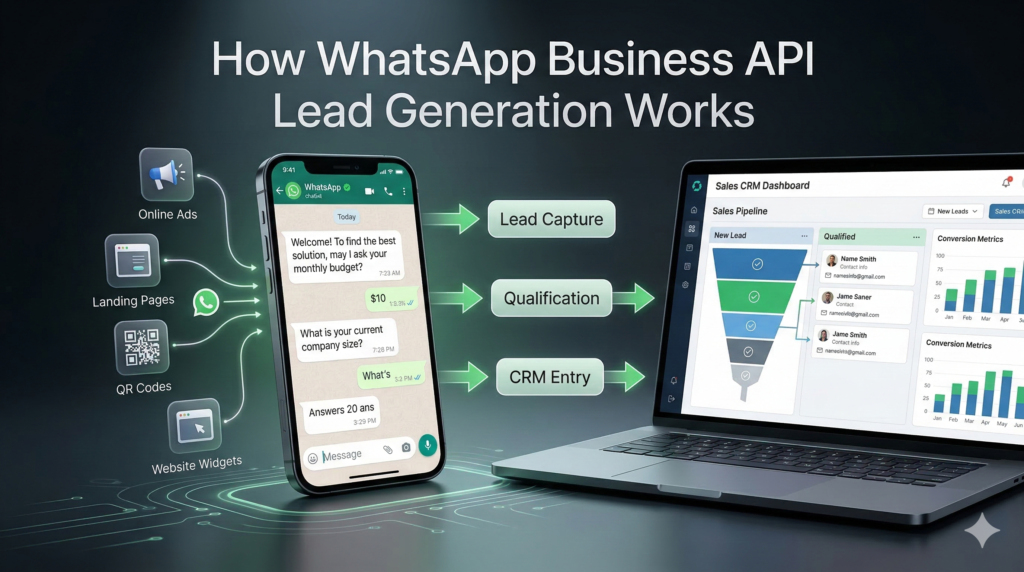
WhatsApp links (for example, wa.me links) can be placed in email signatures, social media bios, digital brochures, or in-app messages. When a user clicks, it opens a WhatsApp chat with your business number. These links can be parameterized to include context, such as the campaign, product, or language, which your backend systems can interpret.
QR codes linked to WhatsApp chats are particularly useful in offline contexts. Events, retail stores, printed flyers, product packaging, and billboards can all display QR codes labeled “Scan to chat on WhatsApp.” This turns otherwise static touchpoints into live lead capture channels.
Website widgets, often floating buttons or chat bubbles, make WhatsApp accessible across your site. When integrated with WhatsApp Business API backends, these widgets can also collect context like the page URL or lead source and attach it to the conversation as metadata.
All of these mechanisms share a common goal: make it as easy as possible for potential customers to start a conversation at the moment of interest, no matter where they are.
Automated Welcome Messages and First-Response Workflows
Once a lead enters WhatsApp, the first few seconds are critical. Automated welcome messages, powered by the WhatsApp Business API and your automation platform, ensure that every inbound message receives an immediate, relevant response.
An effective welcome workflow typically includes:
- A friendly greeting that acknowledges the user and sets expectations.
- A brief explanation of what can be done via WhatsApp (for example, “We can help you with pricing, demos, or product recommendations.”).
- A simple menu of next steps presented as quick replies or numbered options.
For example, a SaaS company might respond with:
“Thanks for reaching out! I can help with:
- Product information
- Pricing and plans
- Book a live demo
- Talk to support”
These first-response workflows both reassure the user that their message has been received and guide them into structured paths. They filter out non-serious inquiries and accelerate serious leads toward the right action, such as scheduling a call or speaking with sales.
Lead Qualification Using Chatbot Questions and Quick Replies
After the initial welcome, lead qualification is the next crucial step. Instead of having sales teams manually ask the same questions repeatedly, businesses can use WhatsApp automation to collect the basic data needed to qualify prospects.
A typical qualification flow might ask:
- What type of customer they are (for example, individual, small business, enterprise).
- Their primary goal or use case.
- Their approximate budget range or desired plan.
- Expected timeline for making a decision.
These questions can be delivered one at a time, using quick replies where possible to minimize typing and cognitive load. For example:
“Which best describes you?
- Freelancer / Solo
- 2–10 employees
- 11–50 employees
- 50+ employees”
Responses feed directly into your CRM fields. High-intent leads—those with immediate timelines, relevant use cases, and suitable budgets—can be flagged and routed to sales representatives, while less qualified leads can enter nurture sequences.
This approach standardizes qualification criteria, reduces manual workload, and ensures that sales teams spend time on the most promising opportunities.
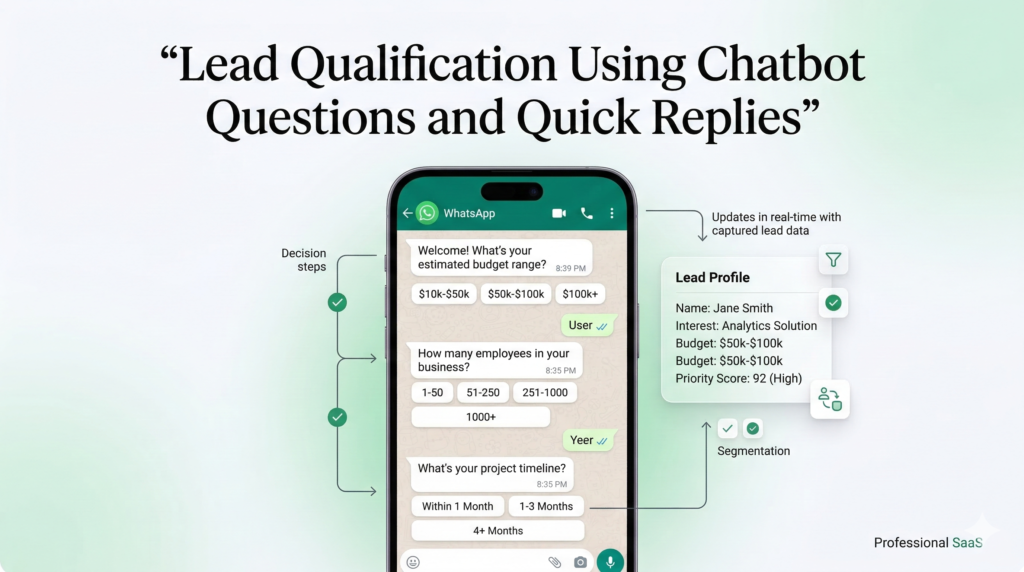
Segmenting Leads Based on Responses and Intent on How WhatsApp Business API Lead Generation Works
With structured qualification data captured via WhatsApp, segmentation becomes much more powerful. Instead of treating all leads the same, you can break them into meaningful groups based on intent and profile.
Common segmentation dimensions include:
- Purchase readiness (hot, warm, cold).
- Company size or role.
- Product interest or use case.
- Region or language.
Segmented leads allow you to tailor follow-up messaging and offers. For instance, high-intent leads might receive immediate human outreach and proposals, while early-stage leads receive educational content and case studies via WhatsApp templates over time.
Segmentation also improves reporting. You can measure conversion rates by segment, understand which campaigns attract the best leads, and adjust targeting accordingly.
CRM Integration for Storing and Tracking Leads
For WhatsApp to be a serious lead generation channel, it must integrate with your CRM. The WhatsApp Business API, when paired with the right integration layer, lets you automatically create or update CRM records whenever conversations occur.
Typical data captured includes:
- Name and phone number from WhatsApp.
- Conversation history or a summarized log.
- Source (click-to-WhatsApp ad, website widget, QR code, etc.).
- Qualification responses and custom fields.
- Stages and activities such as “demo requested,” “proposal sent,” or “contract in review.”
This integration ensures that WhatsApp conversations are not isolated in a messaging tool but are part of your central customer database. Sales teams can see WhatsApp interactions alongside email, calls, and website behavior. Marketing teams can build segments based on messaging engagement. Leadership can track pipeline and revenue influenced by WhatsApp leads.
Lead Nurturing Workflows Using WhatsApp Templates
Not every lead is ready to buy immediately. For those who show interest but are not yet ready to commit, WhatsApp can serve as a powerful nurture channel, provided you design appropriate workflows.
Within the 24-hour messaging window after a user’s last message, you can send free-form messages to provide resources, answer questions, and encourage next steps. For longer-term nurturing (beyond 24 hours), you must use approved WhatsApp templates.
These template-based workflows might include:
- Sharing a relevant case study based on the prospect’s use case.
- Inviting them to a webinar or live demo session.
- Following up on a trial account with usage tips and success stories.
- Checking in after a few days or weeks to see if they are ready to speak to sales.
Each template should deliver clear value and be tied to a legitimate step in the buyer journey. Over time, these touches move prospects closer to readiness while keeping your brand top of mind in a channel they actively use.
Re-Engagement Strategies for Cold Leads
Even well-qualified leads can go cold. WhatsApp provides a channel for respectful, value-driven re-engagement.
Re-engagement strategies might include:
- Sending a concise update about a new feature that directly addresses previously mentioned concerns.
- Offering a time-limited opportunity to revisit a proposal or schedule a call.
- Sharing a success story from a similar customer segment.
- Simply asking if their situation has changed and whether they are still exploring solutions.
Because of WhatsApp’s policies, these messages must use approved templates and should only go to users who have provided appropriate opt-in. Well-timed, relevant re-engagement can revive dormant opportunities and turn them into active deals.
Measuring Lead Quality and Conversion Rates from WhatsApp
Treating WhatsApp as a serious lead channel requires measurement. Key metrics to track include:
- Click-to-chat rate from ads or website elements.
- Conversation start rate (how many visitors actually send the first message).
- Qualification rate (percentage of chats that become qualified leads).
- Conversion rate (leads that move to demo, trial, or purchase).
- Response time and time-to-first-qualified-conversation.
- Revenue attributed to WhatsApp-originated leads.
By comparing these metrics to those from traditional form-based funnels, you can quantify the impact of WhatsApp Business API on your acquisition and sales processes. In many cases, WhatsApp leads show higher conversion rates because they represent users who are willing to engage in real time and express their needs clearly.
Common Mistakes in How WhatsApp Business API Lead Generation Works
Several pitfalls can undermine WhatsApp lead generation efforts:
Over-automation: Relying exclusively on bots without clear options to speak to a human can frustrate serious prospects. Automation should qualify and assist, not block access to people.
No CRM integration: Treating WhatsApp as a standalone inbox leads to lost data and inconsistent follow-up. Without integration, you cannot properly track or optimize performance.
Poor template strategy: Using generic, low-value templates for follow-ups can feel spammy and harm engagement. Templates should be relevant, personalized, and linked to user intent.
Ignoring compliance: Failing to respect opt-in rules and the 24-hour window can lead to delivery issues and account problems. Compliance must be built in from the start.
Lack of segmentation: Treating all leads identically wastes opportunities. Different profiles and levels of intent need different messaging and workflows.
Example: A Business Generating High-Quality Leads Using WhatsApp Automation
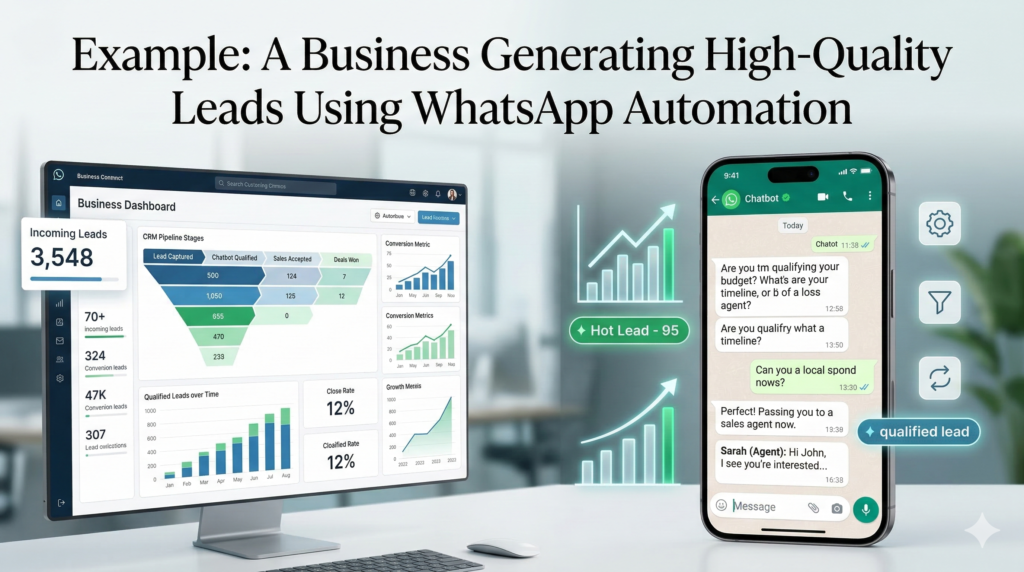
Imagine a B2B SaaS company offering a workflow automation platform. Previously, their lead generation relied on gated eBooks and demo request forms. They observed that many visitors clicked ads and filled forms but never responded to email outreach. Sales cycles were long and unpredictable.
After implementing WhatsApp Business API–based lead capture and automation, they:
- Replaced some “Request Demo” forms with “Chat on WhatsApp” CTAs.
- Ran click-to-WhatsApp campaigns targeting specific industries.
- Built a qualification bot that asked about company size, current tools, and timeline.
- Integrated WhatsApp with their CRM so that qualified leads were assigned to account executives with full context.
- Used WhatsApp templates to share tailored case studies and reminder messages about scheduled demos.
Within a few months, they saw:
- Higher demo booking rates from WhatsApp-originated leads compared to form leads.
- Shorter time from first touch to qualified conversation.
- More focused sales calls, because reps knew the lead’s context ahead of time.
- Clear attribution of deals influenced by WhatsApp, thanks to CRM integration.
WhatsApp did not replace forms and email entirely, but it became a high-performing channel for high-intent prospects who preferred immediate, conversational engagement.
Scaling Lead Generation with WhatsApp Infrastructure
As WhatsApp lead generation proves its value, the next challenge is scale. This requires thinking beyond one-off bots or campaigns and building a sustainable infrastructure.
Scaling might involve:
- Handling higher message volumes by using messaging tiers and multiple numbers for different regions or product lines.
- Expanding entry points across websites, ads, offline channels, and product interfaces.
- Developing modular qualification flows for different segments or offerings.
- Standardizing CRM integration patterns to support multiple teams (sales, success, support).
- Implementing robust monitoring and analytics for response times, lead quality, and conversion performance.
For growth teams, the goal is to treat WhatsApp as a core part of the go-to-market engine—on the same level as paid search, email, and outbound—rather than as an isolated experiment.
With thoughtful design, adherence to WhatsApp’s policies, and strong integration into existing systems, WhatsApp Business API can become a powerful engine for capturing and converting high-intent prospects in a way that feels natural to customers and efficient for teams.