WhatsApp API appointment booking automation streamlines how service businesses manage customer scheduling. Rather than relying on phone calls, email threads, or complex web forms, customers now handle appointments through familiar WhatsApp conversations. Backend systems manage availability checks, confirmations, reminders, and calendar updates automatically while maintaining complete synchronization across teams and platforms.
This structured approach replaces fragmented manual coordination with conversational workflows that operate 24/7 across time zones and locations, creating reliable booking systems that scale with business growth.
The Persistent Challenge of Business Scheduling
Service businesses universally struggle with appointment coordination. Reception staff spend hours daily playing calendar coordinator while customers navigate confusing booking processes. Phone tag consumes time, email threads grow endless as people propose times that don’t work, and web forms see high abandonment rates when customers can’t find suitable slots.
Missed appointments create revenue gaps, double bookings frustrate everyone involved, and last-minute cancellations disrupt carefully planned schedules. Cross-timezone operations compound these issues, as customers in different regions struggle to coordinate with staff working standard business hours.
WhatsApp API appointment booking automation addresses these systematically. Customers express needs naturally through messaging while automation handles the complex calendar logic behind the scenes. Staff focus on service delivery rather than scheduling Tetris.
Why Conversational Booking Through Messaging Works
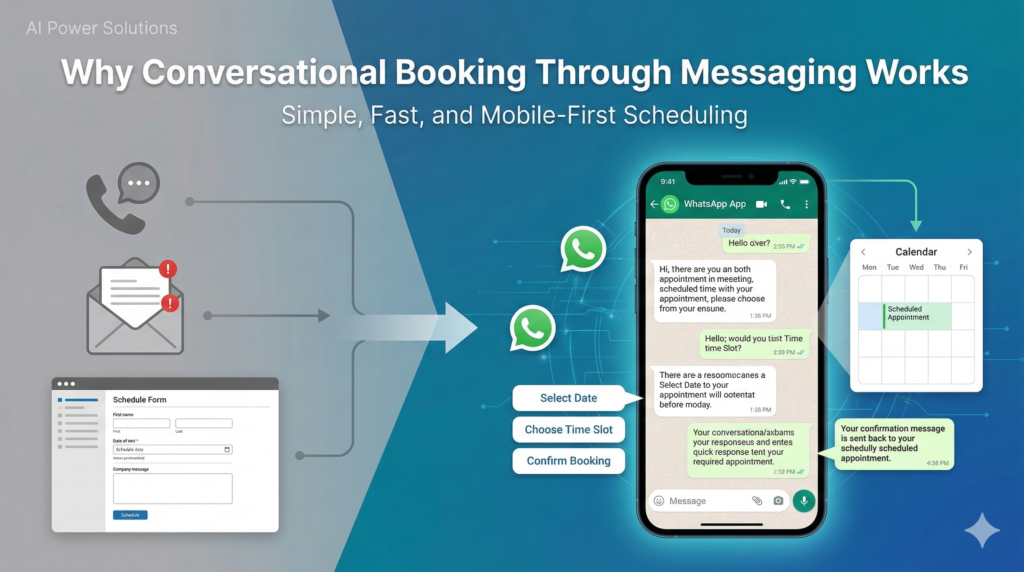
Modern communication patterns favor messaging over traditional forms. Customers live in WhatsApp alongside personal conversations, making it the natural place to handle life administration alongside social interactions. Smartphones dominate service interactions, and people expect to complete tasks from the same device carrying their daily communications.
Unlike rigid web forms requiring desktop access and mandatory field completion, WhatsApp conversations flow naturally. A customer might write, “I’d like to book a consultation for next week, preferably Wednesday afternoon.” The system responds conversationally, “Wednesday works perfectly. Dr. Lee has openings at 2 PM, 3:30 PM, or 5 PM. Which time suits you best?”
This dialogue feels intuitive while gathering precise requirements. Customers can clarify questions instantly, share location preferences, or mention special needs, creating richer context than any dropdown menu could capture. The persistent conversation thread then handles confirmations, reminders, and changes without starting over.
Messaging also eliminates common web form frustrations—no multi-page navigation, no abandoned carts when preferred times aren’t available, no confusion about next steps. Customers complete bookings faster while businesses capture more complete preference data for future interactions.
Enterprise Capabilities of the WhatsApp Business API
The Official WhatsApp Business API transforms consumer messaging into professional scheduling infrastructure. Consumer WhatsApp and Business App work fine for individuals managing personal calendars. Enterprise operations require server-side infrastructure handling thousands of bookings across multiple staff, locations, and time zones.
Key appointment automation features include real-time availability checking against connected calendars, interactive time slot menus where customers tap preferred options, automated confirmation messages containing all critical details, and multi-stage reminder sequences that dramatically reduce no-show rates. The API supports shared team access so reception, service providers, and managers see the same real-time information.
Deep system integrations connect WhatsApp directly to Google Calendar, Microsoft Bookings, CRM platforms, and industry-specific scheduling tools. Every booking conversation creates trackable records while maintaining HIPAA/GDPR compliance where required. Unlike manual WhatsApp chats requiring staff to update separate calendars, API-driven systems maintain perfect synchronization automatically.
Complete System Architecture
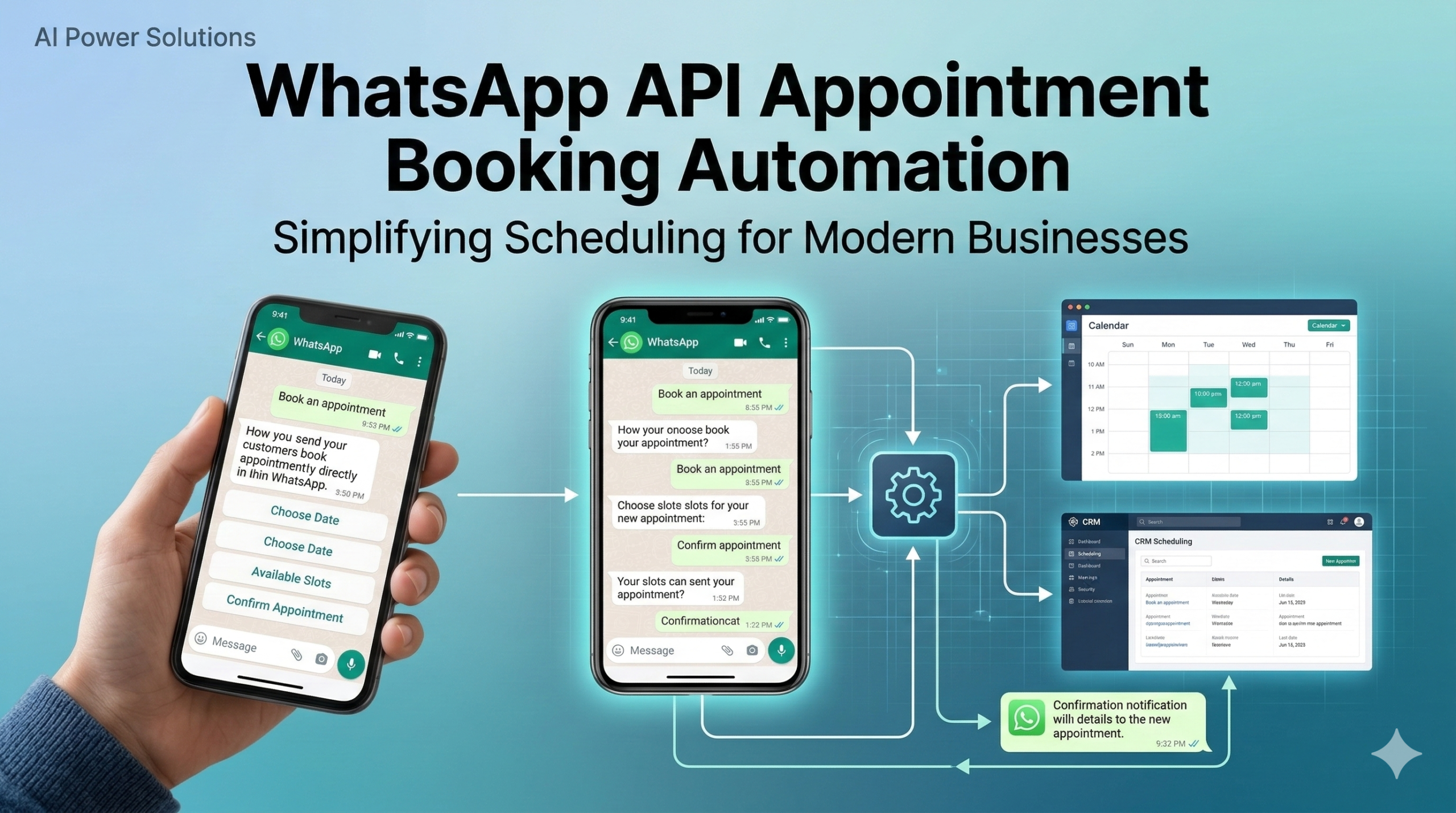
WhatsApp appointment booking automation follows a reliable event-driven flow. When customers tap a website WhatsApp button or message a saved business number, the conversation triggers a webhook event containing sender details and message content. The automation platform immediately activates the appropriate booking workflow.
The system first gathers context through brief, targeted questions covering service type, preferred dates, duration requirements, and location preferences. Behind the scenes, it queries connected calendars to identify genuinely available slots, accounting for staff schedules, service duration plus buffer times, maximum daily appointments per provider, and recurring blackout periods.
Available times appear as clean interactive lists where customers tap their preference. The system places a brief hold on the slot, sends a confirmation preview containing all details, and finalizes the booking upon customer approval. Google Calendar events create instantly, CRM records update with complete interaction history, and reminder sequences schedule automatically based on the appointment date.
If customers need to reschedule or cancel later, the same conversation thread handles modifications through simple self-service options while immediately freeing the original slot for others. This closed-loop automation eliminates double bookings and ensures every system reflects current reality.
Practical Booking Workflows
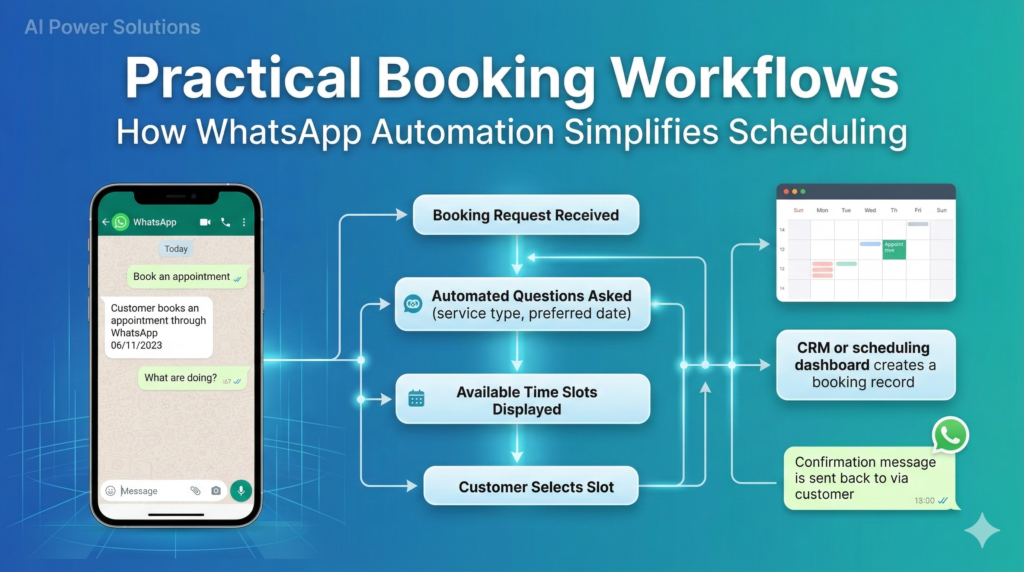
Booking discovery flows start when customers express interest through website buttons, QR codes, or direct messages. The conversation quickly clarifies service requirements and preferences before presenting genuinely available options. Rather than overwhelming customers with dozens of identical slots, intelligent presentation groups times logically by date and provider while respecting business rules around maximum daily appointments.
Time slot selection uses WhatsApp’s native interactive features. Customers see clean lists like “Dr. Patel’s availability next week: Tuesday 10AM, 2PM, 4PM; Wednesday 11AM, 3PM” and tap their preference. The system immediately reserves the slot briefly while preparing a comprehensive confirmation containing provider details, exact location with map integration, preparation instructions, and clear next steps.
Confirmation messages serve as the single source of truth. Customers receive complete information including provider name, precise date and time, location details with navigation links, required documents or preparation, parking information, and contact options for questions. This eliminates “I didn’t know I needed to bring X” confusion that frustrates both customers and staff.
Reminder sequences deploy automatically at optimal intervals. Forty-eight hours prior, customers receive detailed preparation information alongside a confirmation request. Twenty-four hours out brings final logistics and weather considerations. Two hours before serves as the last checkpoint. These multi-touch sequences typically reduce no-shows by 60-80 percent.
Self-service modifications empower customers to reschedule or cancel through the same conversation thread. Simple prompts ask “Keep your March 12th slot, reschedule to new time, or cancel entirely?” Available alternatives appear immediately while the original slot opens for others. Staff only intervene for complex situations.
Calendar and CRM System Integration
Effective WhatsApp appointment booking requires tight integration with existing scheduling infrastructure. Google Calendar connections create events instantly when customers confirm, delete them upon cancellation, and query availability in real time. Two-way synchronization ensures WhatsApp always reflects current reality regardless of external changes.
Calendly integration maps WhatsApp conversations to specific event types, presenting only appropriate available times while respecting embedded business rules around buffer periods and maximum daily events. CRM platforms like HubSpot and Salesforce create contact records enriched with complete booking history, service preferences, and interaction context for future sales and marketing use.
Industry-specific platforms receive tailored integration. Healthcare systems like SimplePractice and Cerner create patient appointments with clinical notes. Salon platforms like Vagaro and Mindbody handle service-specific durations and stylist availability. Real estate tools like ShowingTime coordinate property tours across agent schedules.
All integrations follow the same pattern: WhatsApp conversation triggers calendar query, customer selection creates provisional hold, final confirmation commits across systems, and subsequent changes propagate everywhere simultaneously. This eliminates the “calendar dance” where staff manually reconcile multiple systems.
Industry Applications and Customer Impact
Healthcare clinics use WhatsApp appointment booking automation for patient consultations, follow-up visits, and specialist referrals. Patients select from available providers and times, receive preparation instructions including insurance requirements, and get reminders accounting for clinic location and traffic patterns. No-show reduction directly impacts revenue while reception staff focus on clinical coordination rather than phone schedules.
Real estate agencies coordinate property viewings across multiple agents and locations. Prospects message interest in specific listings and receive available tour times from qualified agents covering that neighborhood. Interactive maps and driving directions eliminate “where exactly” confusion while CRM integration captures complete lead qualification data for follow-up.
Service businesses including HVAC, plumbing, and cleaning companies book on-site visits through WhatsApp flows considering technician location, service duration, and customer urgency. Customers select from 30-minute arrival windows while receiving technician profiles and vehicle information beforehand, building trust before the visit occurs.
Educational institutions schedule academic advising, admissions interviews, and parent-teacher conferences through department-specific booking flows. Students see only hours when their assigned advisor actually works while parents receive childcare-friendly time clusters. Centralized records feed into student information systems automatically.
Consulting firms arrange discovery calls and strategy sessions across practice areas. Prospects qualify through brief WhatsApp conversations before seeing consultant availability filtered by expertise and seniority. Complete interaction history flows into CRM systems for relationship managers.
Across industries, conversational booking delivers higher completion rates, richer customer data, and dramatically reduced no-show rates compared to traditional methods.
WhatsApp Messaging Compliance for Appointments
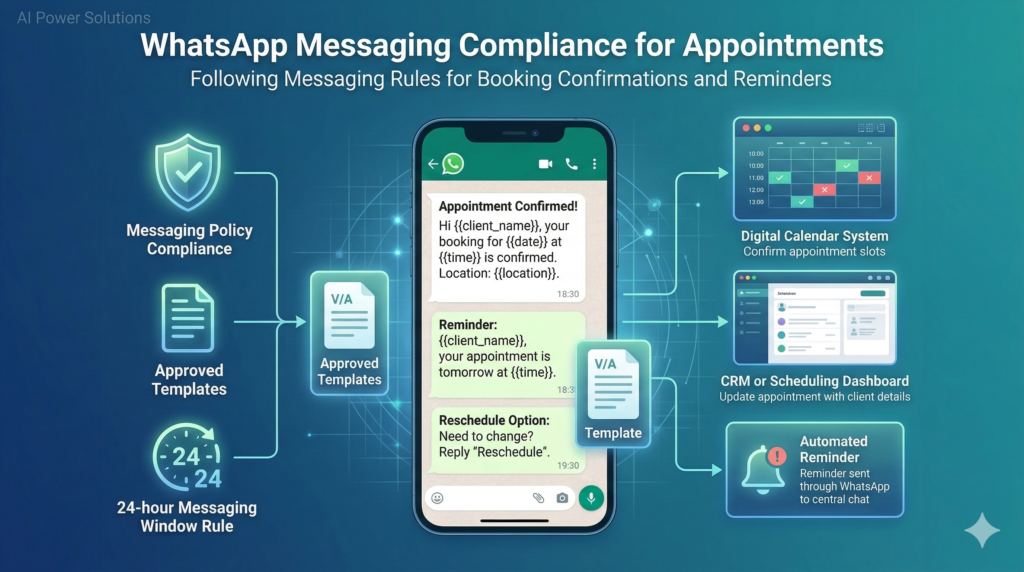
Business-initiated messages outside the 24-hour customer service window require pre-approved templates. Appointment automation uses these strategically for confirmations and reminders while handling most interactions within active conversation windows.
Utility templates confirm bookings with variables for provider names, dates, times, and locations. Reminder templates deploy at 48-, 24-, and 2-hour intervals with escalating urgency and detail. Rescheduling alerts notify customers of changes while cancellation confirmations free calendar slots immediately.
Compliance requires clear opt-out language in every template, accurate subject categorization, and content matching approved specifications exactly. Personalization through variables maintains relevance while satisfying platform policies. Well-designed template libraries support dozens of appointment scenarios across service types, providers, and locations.
Tangible Operational Benefits
Administrative teams save 60-80 percent of scheduling coordination time as automation handles discovery, availability presentation, confirmation, and reminders. Reception staff redirect hours daily toward revenue-generating activities or complex customer needs.
No-show rates drop dramatically through multi-stage reminders tailored to appointment type and customer history. Clinics serving appointment-heavy models recover thousands monthly in lost revenue. Service businesses fill cancelled slots faster through real-time availability propagation.
Booking velocity accelerates as customers complete scheduling in 60-90 seconds versus 5-7 minutes for web forms. Mobile abandonment disappears entirely. Conversational flows convert 2-3 times more inquiries into confirmed appointments.
Customer experience improves through instant responses, flexible self-service modifications, rich contextual information, and familiar interface. Businesses capture complete preference data enabling smarter future recommendations and personalization.
Centralized records eliminate data silos. Every booking interaction feeds CRM systems with service preferences, urgency indicators, and relationship history. Sales and marketing teams access complete customer context rather than fragmented notes.
Avoiding Common Implementation Pitfalls
Overly complex conversation flows frustrate users. Limit discovery to 3-4 essential questions maximum before presenting time options. Always offer clear human escalation paths for edge cases or urgent needs.
Poor calendar synchronization creates the worst customer experiences. WhatsApp must reflect genuine availability accounting for all business rules including buffer times, maximum daily appointments, and staff preferences. Provisional holds prevent race conditions when multiple customers select simultaneously.
Generic reminders fail to engage. Effective sequences provide specific logistical information, weather considerations, preparation requirements, and clear action requests. Personalization mentioning provider names and exact locations drives higher confirmation rates.
Missing human escalation traps customers in automation loops. Every flow must include prominent “talk to receptionist” options with full conversation context passed to live agents. Complex needs require human judgment that bots cannot provide.
Ignoring peak capacity leads to burnout. Systems should load balance across available providers and gracefully handle overflow through waitlists or alternative suggestions rather than accepting every request.
Emerging Trends in Scheduling Automation
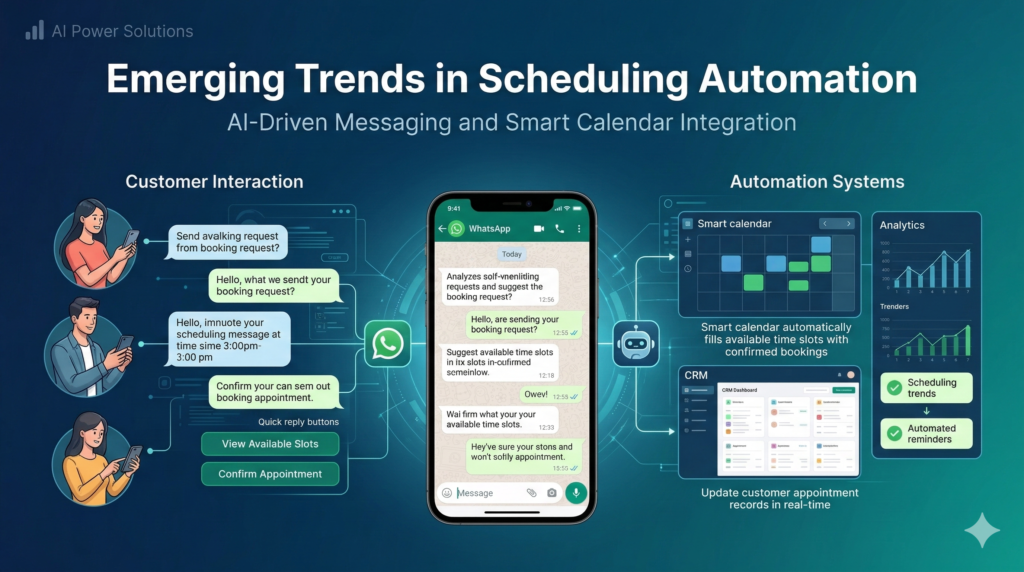
AI-powered scheduling assistants will parse completely natural language requests like “dentist appointment next Tuesday afternoon when my kids are at school” and return genuinely workable options across all available providers. Contextual awareness will consider past booking patterns, service urgency, and customer lifecycle stage.
Predictive scheduling analyzes historical data to suggest optimal booking windows before customers think to request them. Monthly service customers receive proactive availability nudges while lapsed patients get targeted re-engagement flows.
Integrated payment collection at booking time further reduces no-shows. Customers complete deposits through secure links while receiving immediate confirmation. Revenue becomes more predictable across appointment-heavy models.
Omnichannel synchronization creates seamless experiences across WhatsApp, websites, phone systems, and in-person reception. Customers choose their preferred interface while businesses maintain single unified calendar truth.
Conclusion: Structured Conversational Scheduling
WhatsApp API appointment booking automation eliminates manual coordination bottlenecks that plague service businesses. Customers experience simple, natural booking conversations while backend systems handle complex calendar logic, provider load balancing, and compliance requirements automatically.
Businesses achieve 60-80 percent administrative time savings, dramatically reduced no-show rates, accelerated booking velocity, and complete interaction data flowing into CRM systems. Reception teams redirect hours daily toward revenue-generating activities while maintaining personal customer relationships.
Structured conversational booking delivers higher completion rates, richer customer insights, and operational efficiency that scales across locations, teams, and time zones. Manual phone tag and email Tetris become relics of pre-messaging business operations.
AIPowerSolutions.in specializes in WhatsApp API appointment booking automation and scheduling system integrations, helping service businesses create reliable conversational booking infrastructure that grows with their customer base while preserving the human relationships that drive repeat business.