Introduction
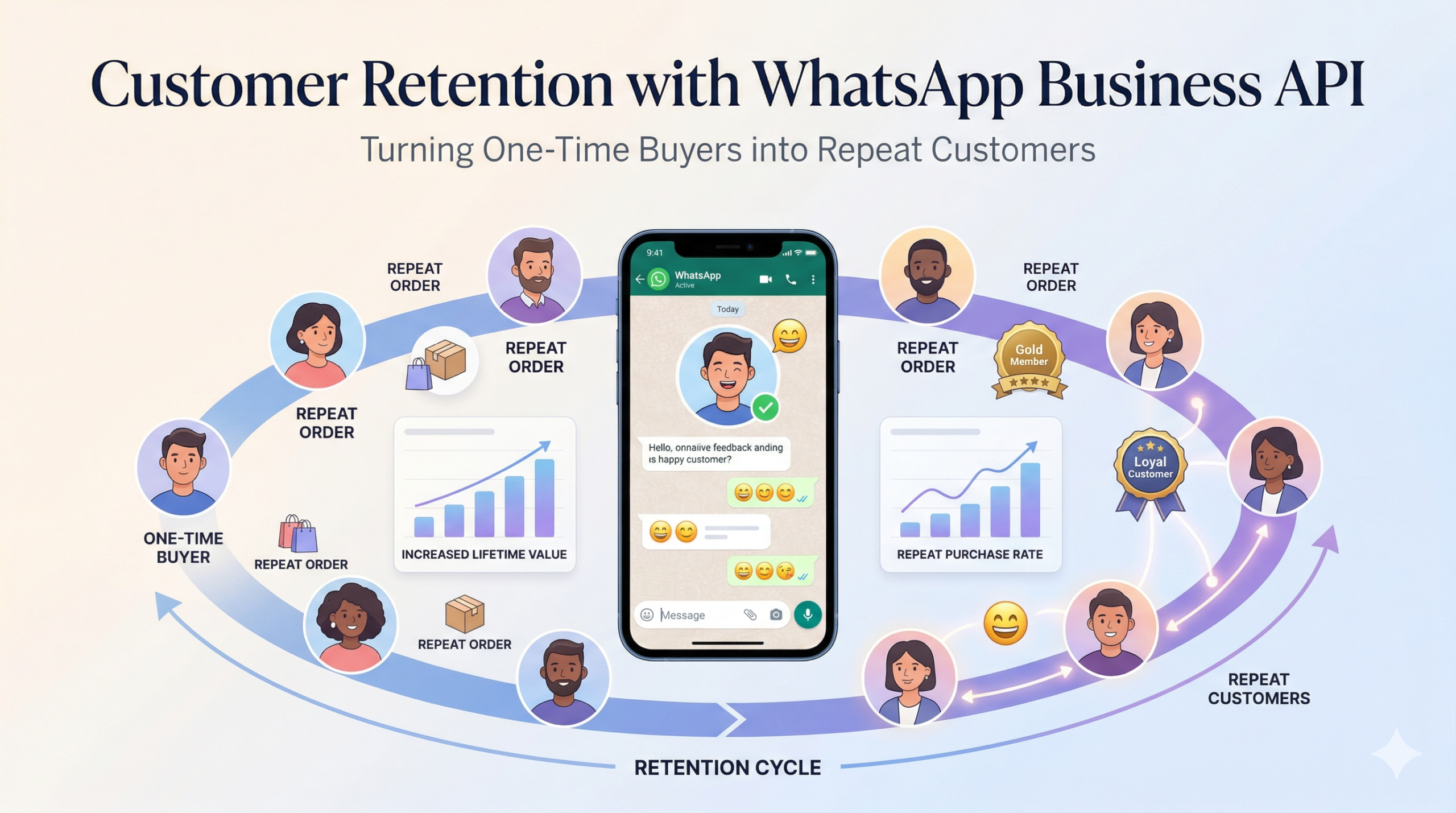
WhatsApp Business API customer retention is becoming a key strategy for modern businesses. Acquiring a new customer costs significantly more than retaining an existing one, and repeat customers tend to buy more often, spend more per transaction, and refer others. Yet many businesses still treat the moment of purchase as the end of the journey rather than the beginning of a relationship. After the first order or subscription, customers often receive little to no follow-up, no meaningful support, and no relevant offers. These weak or missing follow-ups leave gaps where competitors can step in, and they turn high-potential first-time buyers into lost revenue. WhatsApp Business API gives brands a way to close those gaps and nurture relationships through direct, real-time communication in a channel customers actively use every day.
By using WhatsApp as a structured retention channel instead of just a support line, businesses can create ongoing, value-driven touchpoints that feel useful rather than intrusive. With a thoughtful combination of automation, personalization, and integration, WhatsApp can become a powerful engine for engagement, repeat purchases, and long-term loyalty.
Continuous Post-Purchase Engagement with WhatsApp
WhatsApp is uniquely suited for post-purchase engagement because it combines immediacy, familiarity, and high open rates. Customers already trust it as a daily communication tool, and they are far more likely to see and read a WhatsApp message than an email buried in their inbox. After a purchase, this gives businesses a direct path to continue the conversation in a helpful, non-disruptive way.
Instead of sending a single order confirmation and disappearing, brands can use WhatsApp to guide customers through the first days and weeks of product use or service onboarding. Customers can ask questions, report issues, or request help without searching for contact forms or support portals. The same conversation thread that handled pre-purchase questions can now host post-purchase support, guidance, and offers. This continuity makes the experience feel cohesive and lowers the perceived effort required to stay connected with the brand.
For service and SaaS providers, WhatsApp can also bridge the gap between sales and success teams. Once a deal closes, the conversation does not need to move to a different system or channel. Instead, a new phase of the same chat begins, focused on activation, value realization, and long-term engagement. That smooth transition is fundamental to retention, because customers rarely churn when they feel supported and see clear value quickly.
Retention Workflows: Onboarding, Tips, Reminders, and Feedback
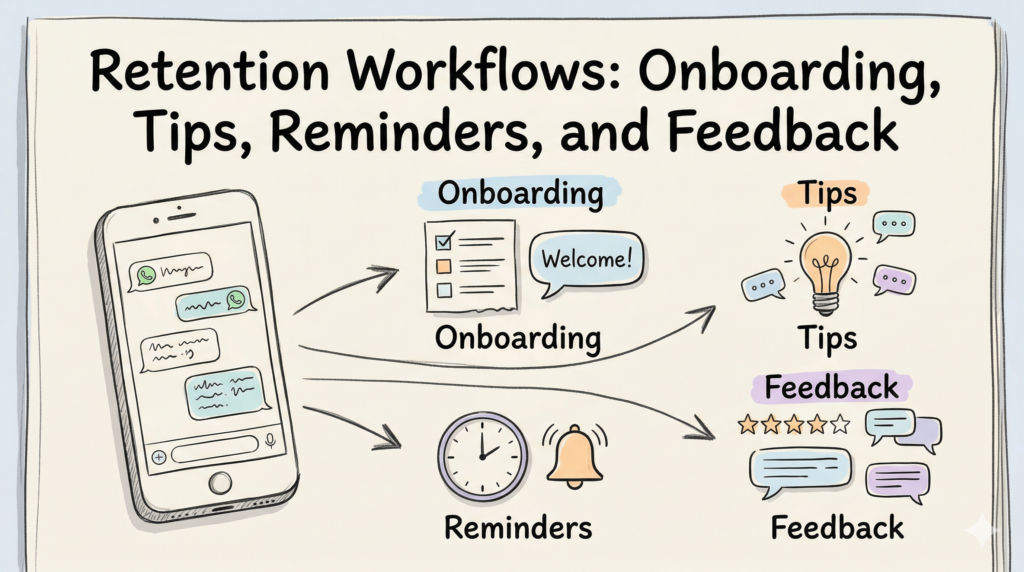
Effective retention relies on structured, repeatable workflows that match the customer lifecycle. WhatsApp Business API makes it possible to design and automate these workflows as message sequences, triggered events, and responsive flows that keep customers engaged without overwhelming them.
Onboarding messages play a crucial role in the first hours and days after purchase. For a D2C product, onboarding might include a welcome message, unboxing guidance, basic usage instructions, and links to detailed FAQs or videos. For a SaaS product, onboarding could provide login details, a quick start checklist, and recommended first actions. These messages help customers get value quickly and reduce the chance that confusion or friction leads to dissatisfaction.
Product usage tips extend this support over time. Instead of a one-time manual, customers can receive periodic, context-aware tips tailored to typical milestones. For example, a skincare brand might share how to adjust routine after a week, or what to expect after a month. A SaaS company might offer best practices, shortcuts, or feature spotlights as the user’s activity grows. These touchpoints deepen engagement and help customers discover more value in what they already bought.
Reorder and renewal reminders directly influence retention and revenue. For consumable products, WhatsApp can send reminders when the customer is likely to be running low, with one-tap reorder options. For subscriptions, reminders can highlight upcoming renewals, usage patterns, or upgrade opportunities. Timing and relevance matter here: the goal is to be helpful, not intrusive.
Feedback collection is another critical workflow. Post-purchase surveys, NPS questions, or simple “How did it go?” prompts help businesses understand satisfaction, identify issues early, and demonstrate that they care. When feedback reveals problems, a follow-up conversation can turn a potentially lost customer into a retained one through quick action and personal attention.
Personalization and Long-Term Relationships
Personalization sits at the heart of retention. Customers are more likely to stay when they feel understood and valued, not treated as entries in a list. WhatsApp Business API, when connected to customer data, allows businesses to tailor messages based on behavior, preferences, and history.
Instead of generic broadcasts, brands can send messages that reflect what a customer bought, how often they purchase, and what they have asked in previous conversations. Product recommendations can relate to complementary items rather than random promotions. Usage tips can match the specific plan, configuration, or profile. Reminders can align with actual usage cycles and previous reorder patterns.
Over time, WhatsApp can evolve from a transactional channel into a relationship channel. The tone can acknowledge tenure, milestones, or loyalty. This strengthens emotional connection and reduces churn.
Automation for Consistent, Scalable Engagement
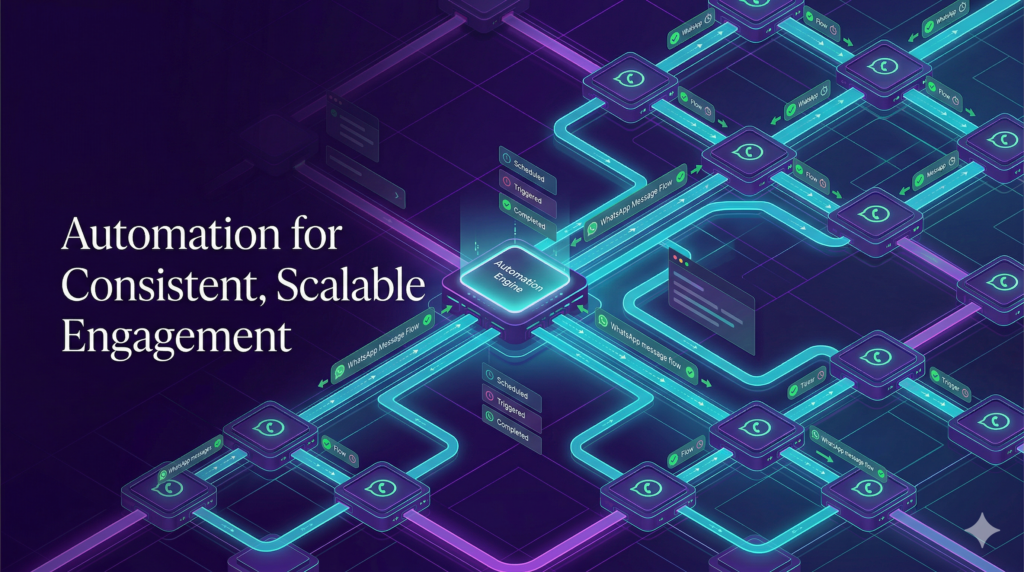
Maintaining ongoing, personalized engagement for thousands of customers would overwhelm any team without automation. WhatsApp Business API enables automation that supports retention at scale while still leaving room for human interaction.
Automation handles onboarding, reminders, feedback prompts, and routing. It ensures consistency and prevents customers from being missed. At the same time, human agents step in when deeper interaction is needed.
This balance improves efficiency while maintaining a strong customer experience.
Practical Example: A D2C Brand Boosting Retention
Consider a D2C wellness brand that struggled with repeat purchases. After adopting WhatsApp Business API, it introduced onboarding messages, usage tips, reorder reminders, and feedback prompts. With WhatsApp Business API customer retention workflows, brands can automate engagement.
Customers received timely, relevant communication, leading to higher satisfaction. Repeat purchases increased, churn reduced, and overall retention improved significantly.
CRM Integration and Lifecycle-Based Communication
Integrating WhatsApp with CRM systems creates a unified customer view. Businesses can track lifecycle stages and send targeted messages accordingly.
New customers receive onboarding, loyal customers get rewards, and at-risk customers receive re-engagement messages. This makes communication more relevant and effective.
Measuring Retention: Metrics That Matter
Retention success depends on tracking the right metrics. These include repeat purchase rate, engagement rate, churn rate, and customer lifetime value.
Analyzing these metrics helps businesses refine strategies and improve long-term performance.
Conclusion: WhatsApp as a Long-Term Retention Engine
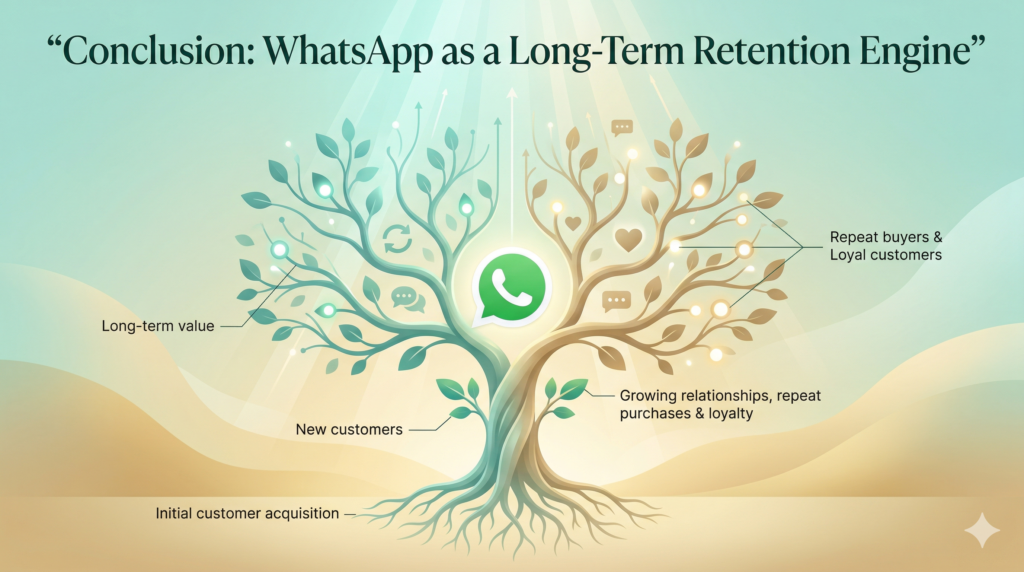
Customer retention requires consistent, value-driven communication. WhatsApp Business API enables businesses to maintain real-time, personalized engagement that builds trust and loyalty.
With automation, CRM integration, and structured workflows, WhatsApp becomes more than a messaging tool—it becomes a retention engine that drives long-term growth.
FAQ
1. How does WhatsApp Business API support customer retention?
It enables continuous engagement through onboarding, reminders, and personalized communication.
2. What workflows are most effective?
Onboarding, product tips, reorder reminders, and feedback collection.
3. Will customers find messages intrusive?
Not if they are relevant, timely, and personalized.
4. How does automation help?
It ensures consistent communication while freeing teams from repetitive tasks.
5. Why is CRM integration important?
It provides context for personalized, lifecycle-based messaging.
6. What metrics should be tracked?
Repeat purchase rate, engagement, churn rate, and customer lifetime value.
7. Can SaaS and D2C both use this?
Yes, both can use WhatsApp for long-term engagement and retention.