Introduction
Customer buying behavior has shifted decisively toward messaging-first interactions. Across India and many other markets, people now prefer to discover products, ask questions, and complete purchases inside the same apps they use to talk with friends and family. WhatsApp has become the default communication layer for millions of users, making it a natural environment for commerce. Traditional checkout flows—landing pages, multi-step forms, and external redirects—create friction at almost every touchpoint. In contrast, a guided conversation inside WhatsApp feels lighter, faster, and more familiar than a formal website funnel.
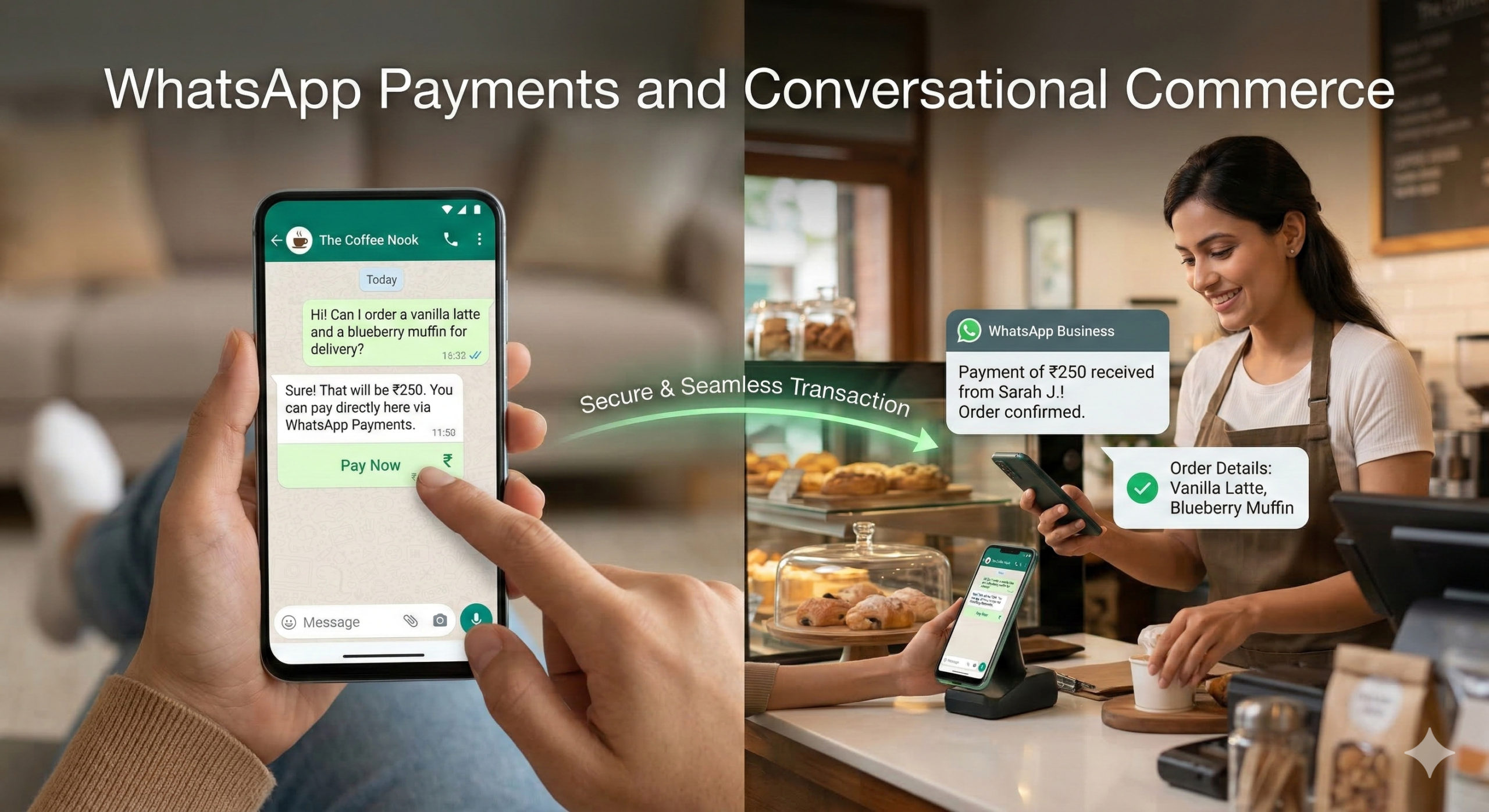
WhatsApp Business API sits at the center of this shift. It enables brands to move beyond basic broadcast messages and build full-funnel journeys that combine product discovery, real-time support, and in-chat payments. For Indian D2C brands and B2B SaaS companies WhatsApp Payments and Conversational Commerce, this approach turns WhatsApp into a high-value commerce and relationship channel. When designed well, the entire journey from “Hi” to “Order confirmed” can happen inside a single, coherent conversation.
What Conversational Commerce Means on WhatsApp
Conversational commerce turns commerce into an interactive, real-time dialogue instead of a static pipeline. Instead of pushing customers through a series of pages, businesses use messaging to understand intent, provide recommendations, answer questions, and capture orders in a natural way. This approach works especially well on WhatsApp because users already trust the channel and treat it as a personal space.
WhatsApp has become a central channel for conversational commerce thanks to its scale and features. In India, hundreds of millions of people use WhatsApp every day, including customers in Tier-2 and Tier-3 cities who may not be comfortable with traditional e-commerce interfaces but are highly active on messaging. WhatsApp Business API lets brands scale these one-on-one conversations with automation, templates, and structured messages while keeping the experience feel human.
The key advantage is that WhatsApp Business API turns open-ended chats into guided journeys. A customer can still type freely, but the business can respond with product catalogs, interactive buttons, and list messages that guide them step by step. The result is a friction-reduced experience where the user feels like they are chatting with a helpful sales or support agent, but the business is running a well-designed commercial flow.
Product Discovery Inside Chat: Catalogs, Buttons, and Lists
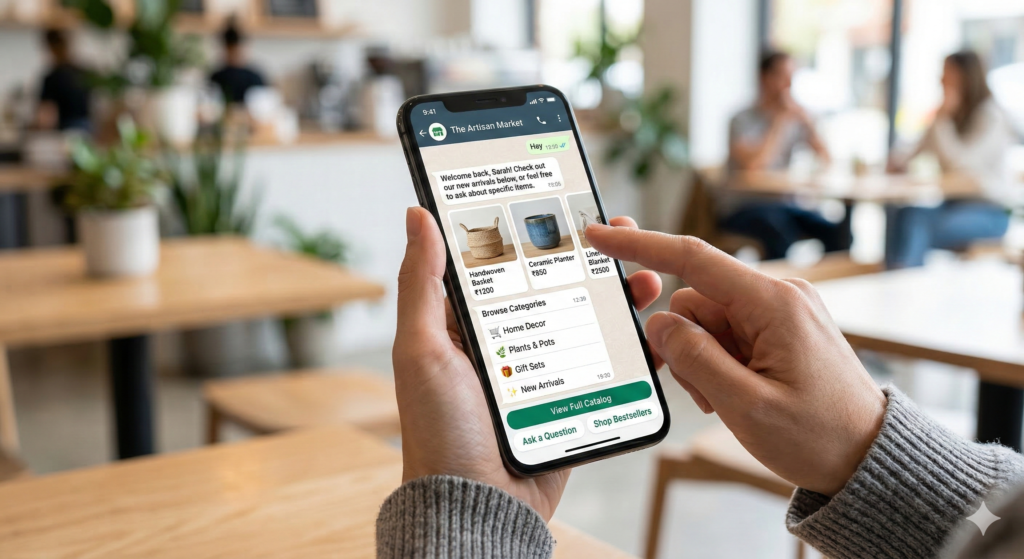
For Indian D2C brands, WhatsApp often replaces the website as the first touchpoint for product discovery. Instead of driving traffic to a landing page, brands can use WhatsApp catalogs to showcase inventory directly inside the app. Each product appears as a card with an image, name, short description, and price. Customers can scroll through categories, open individual items, and share them with friends from the same chat. This mirrors the “sharing a screenshot” behavior that is already common in India, but in a more structured and brand-controlled way.
Interactive buttons and list messages then help users navigate without typing. A D2C fashion brand can send a list of categories such as “T-shirts,” “Joggers,” and “Accessories.” Or it can ask, “What are you shopping for?” with buttons for “Men,” “Women,” and “Kids.” After a category is selected, the brand can send curated product sets, size options, and color variants in a single thread. This conversational browsing feels lighter than scrolling a website and reduces the cognitive load for first-time buyers.
SaaS and B2B brands can apply the same logic to services instead of products. A SaaS company can use list messages to let prospects choose between “Learn more,” “Book a demo,” or “Talk to sales.” The assistant can then guide them through a short qualification flow, asking about team size, use case, and budget. Interactive buttons can surface pricing tiers, trial options, or upgrade paths. The entire exchange links back to the CRM, so the conversation becomes a data-rich lead instead of a static form submission.
The In-Chat Payment Journey: From Cart to Confirmation
Once a customer has selected products, the payment journey begins inside WhatsApp. For D2C brands, this usually starts with a cart summary that lists items, quantities, and prices. Customers can confirm or edit their order directly from the chat, using buttons like “Proceed to payment,” “Remove item,” or “Add more.” If the user is new, the business can collect address and contact details in small steps, not a long form.
For Indian D2C brands, payment often leverages local methods such as UPI, cards, or digital wallets. Depending on the region and provider, customers may see an in-app payment prompt or a secure link that opens a familiar payment interface. The transaction is processed by a compliant payment gateway, and the result is sent back to the brand’s commerce system. From the customer’s perspective, they stay inside WhatsApp for most of the journey, only briefly leaving to complete the payment. This keeps the experience continuous and low-friction.
For SaaS and B2b Brands
For SaaS and B2B brands, the equivalent of a “cart” is often a subscription upgrade, seat increase, or project quotation. Instead of sending users to a separate billing portal, the business can present structured messages with pricing details and payment options. The assistant can then trigger a secure payment flow within the same chat. After a successful transaction, the system updates the user’s license, sends welcome materials, and opens a support thread for onboarding. This turns payments into a natural extension of the conversation instead of a separate, cumbersome process.
After payment, WhatsApp becomes the primary channel for post-purchase communication. The brand can send order confirmations, shipping updates, and delivery tracking through the same thread, often with interactive buttons such as “Track shipment” or “Modify delivery.” For D2C brands, this transparency reduces support queries; for SaaS companies, it improves onboarding and reduces churn by keeping customers engaged at key moments.
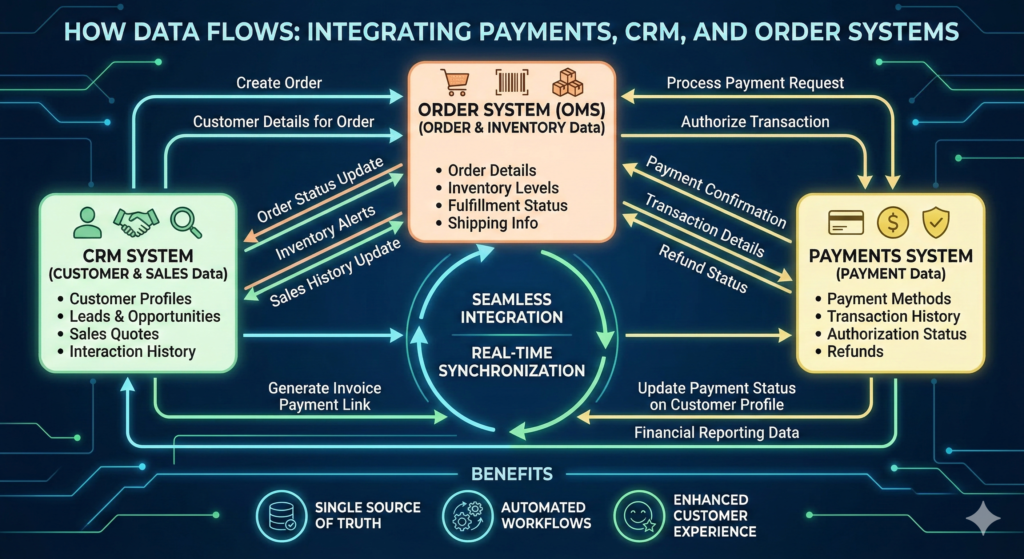
How Data Flows: Integrating Payments, CRM, and Order Systems
The smooth experience customers see in WhatsApp relies on tight integrations between WhatsApp Business API, payment gateways, CRM platforms, and order or subscription management systems. For D2C brands, this usually means syncing WhatsApp carts with an e-commerce backend such as Shopify, WooCommerce, or a custom CMS. Each product selection in WhatsApp appears in the backend cart, and inventory, pricing, and discount logic are enforced there.
When a customer completes a payment, the system passes the order details and transaction ID to the payment gateway. The gateway performs risk checks, processes the payment, and returns the status to the backend. This status update triggers WhatsApp messages—confirmations for success, retry prompts for failures, or status updates for pending transactions. Inventory can be decremented, and fulfillment workflows can be initiated automatically, while the chat thread stays in sync with the real-world order state.
For SaaS and B2B brands, the same logic connects WhatsApp conversations with CRM and billing systems. When a prospect books a demo or signs up for a trial, the CRM captures that interaction and assigns a lead stage. Subsequent messages can be personalized based on the lead’s profile, product usage, or trial activity. If the user upgrades their plan, the billing system updates the subscription, and the same chat thread can be used to share invoices, usage insights, and renewal reminders. This end-to-end integration turns WhatsApp from a messaging channel into a full-funnel revenue engine.
Indian D2C Example: Turning Chats into Sales
An Indian D2C beauty brand that sells skincare and hair-care products offers a clear example of how WhatsApp commerce can transform the customer journey. Before adopting WhatsApp Business API, the brand relied on social media ads that drove traffic to its website. The traffic numbers were healthy, but many visitors dropped off at checkout. They often had questions about ingredients, skin types, or usage instructions, and support was limited to email or generic FAQs.
After implementing WhatsApp commerce, the brand redesigned its funnel around conversations. Click-to-WhatsApp ads invited users to start a chat, where an automated assistant greeted them and asked a few questions about skin type, concerns, and budget. Based on the answers, the assistant presented personalized product recommendations from the WhatsApp catalog. Customers could ask questions, and the assistant either answered instantly or escalated to a human agent during peak hours.
Once a customer selected products, the assistant summarized the cart and enabled checkout directly from WhatsApp, using a secure payment link. After payment, the brand sent order confirmations, shipping updates, and delivery tracking through the same thread. A few days after delivery, the customer received a follow-up message asking for feedback and suggesting related products. The result was a clear increase in conversion rates, a reduction in cart abandonment, and a rise in repeat purchases from customers who found the experience fast, familiar, and easy to trust.
SaaS-First Example: B2B Conversations and In-Chat Upgrades
For a B2B SaaS provider, WhatsApp plays a different but equally important role. Imagine a mid-sized SaaS company that offers a cloud-based analytics platform with tiered pricing and a freemium model. Traditionally, the company used website forms and email sequences to qualify leads, book demos, and convert free users to paid plans. Many prospects never completed the forms or responded to cold emails, and the sales team spent significant time chasing leads that went cold.
With WhatsApp Business API, the brand added a click-to-WhatsApp option on its website and in key product screens. When a free user clicked, they entered a WhatsApp chat where an AI-assisted assistant asked about their role, team size, and use case. Based on the answers, the assistant recommended a suitable plan, summarized pricing, and offered to book a demo or start a trial. The entire qualification process happened in a few short, interactive messages instead of a long form.
For users who wanted to upgrade, the assistant could send a structured message with plan details and a payment link, then guide them through the upgrade in chat. After the payment, the system automatically updated the user’s license, sent a welcome message, and opened a support thread for onboarding. The same WhatsApp channel was later used for renewal reminders, usage tips, and upsell offers. This turned WhatsApp into a continuous relationship layer that reduced friction at every stage of the B2B funnel.
Compliance, Security, and Building User Trust
Because WhatsApp commerce involves payments and personal data, compliance and security are critical for both D2C brands and SaaS companies. In India, this means aligning with data protection expectations, securing payment information, and clearly explaining how customer data will be used. WhatsApp’s own policies require explicit opt-ins for marketing messages and strict adherence to template guidelines, so businesses must design their flows with permission and transparency.
Payment data is typically handled by certified gateways, not stored directly in WhatsApp. The brand’s role is to ensure that links to payment pages are secure, that transactions are encrypted, and that users understand the payment method they are using. For D2C brands, this also means clear labeling of offers, shipping costs, and return policies within the chat. For SaaS companies, it involves transparent pricing, contract terms, and billing cycles, all communicated in a way that feels natural inside the conversation.
User trust is reinforced by verified business profiles, consistent branding, and respectful communication practices. Avoiding spammy broadcasts, respecting opt-out requests, and limiting promotional messages to genuinely relevant segments all help maintain long-term trust. When issues arise—such as failed payments, delivery delays, or support tickets—prompt, transparent communication within WhatsApp can prevent frustration and strengthen the relationship.
Reducing Abandonment with Conversational Follow-Ups
Cart or intent abandonment is a major challenge for both D2C and SaaS brands, and WhatsApp is one of the most effective channels to recover lost opportunities. For D2C retailers, automated reminders can nudge users who added products to their cart but did not complete checkout. These reminders can reference the specific items, address common objections (“limited stock,” “last size available”), or offer assistance (“Need help choosing?”). Because WhatsApp messages are highly visible and interactive, customers are more likely to respond and complete the purchase.
For SaaS companies, the same logic applies to trial users or prospects who showed interest but did not convert. A well-timed WhatsApp message can ask if they encountered any blockers during onboarding, offer a quick demo, or extend a limited-time discount. These conversations feel less like marketing and more like personalized support, which increases the likelihood of conversion. Over time, brands can refine their follow-up logic based on behavior—such as how long a user has been active, which features they used, or which plan they viewed—so that each message feels relevant and timely.
The Future: AI-Driven Buying Assistants and In-Chat Transactions
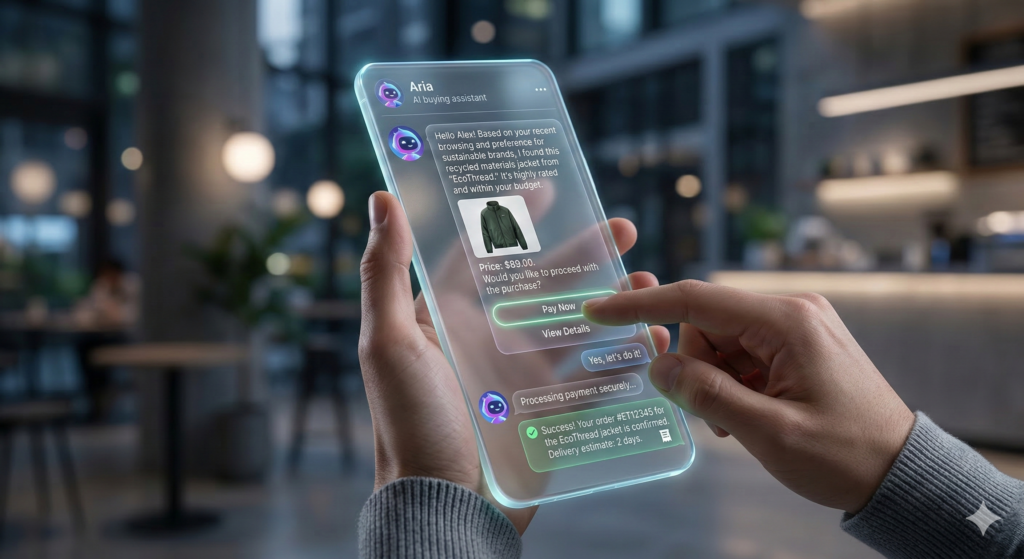
Looking ahead, conversational commerce on WhatsApp will become more intelligent and deeply embedded in the customer journey. AI-driven buying assistants will move beyond simple scripts and understand nuanced intent and context. For Indian D2C brands, this could mean assistants that recommend products based on regional preferences, seasonal trends, and past purchases, all in local languages and a culturally familiar tone. For SaaS companies, AI agents will be able to guide technical buyers through complex configurations, answer integration questions, and suggest pricing scenarios in real time.
In-chat transactions will also become more seamless and native. As payment ecosystems and regulations evolve, customers will be able to complete more types of transactions—subscriptions, renewals, invoices, and high-value orders—without leaving WhatsApp. Combined with AI, this will enable scenarios where a user simply describes what they need, and the system handles matching, pricing, and payment in a single, guided flow. For D2C brands, this means turning WhatsApp into a full-scale commerce channel. And For SaaS companies, it means turning the same channel into a continuous relationship and revenue engine.
For both Indian D2C brands and B2B SaaS providers, the strategic opportunity is to treat WhatsApp not as an add-on channel, but as a core part of the commerce and customer-experience stack. Those who invest in integrated, compliant, and conversational flows will be best positioned to meet the expectations of customers who increasingly want fast, human-like, and frictionless buying experiences—right inside the chat app they already live in.
FAQ
What is conversational commerce on WhatsApp?
Conversational commerce on WhatsApp is the use of chat-based interactions to guide users from product discovery to purchase within a single conversation.
Can users complete payments inside WhatsApp?
Yes, users can complete payments through integrated gateways, usually via secure links or in-app flows, while staying close to the chat experience.
Is WhatsApp suitable for both D2C and SaaS businesses?
Yes, D2C brands use it for product sales and order management, while SaaS companies use it for lead qualification, upgrades, and ongoing customer engagement.
How does WhatsApp reduce cart abandonment?
WhatsApp allows businesses to send timely, personalized follow-up messages that remind users about their cart and help them complete the purchase.
Is WhatsApp commerce secure?
Yes, when implemented with secure payment gateways and proper compliance, WhatsApp provides a safe environment for transactions.
What is the future of WhatsApp commerce?
The future includes AI-driven assistants, deeper integrations, and seamless in-chat transactions across products, services, and subscriptions.