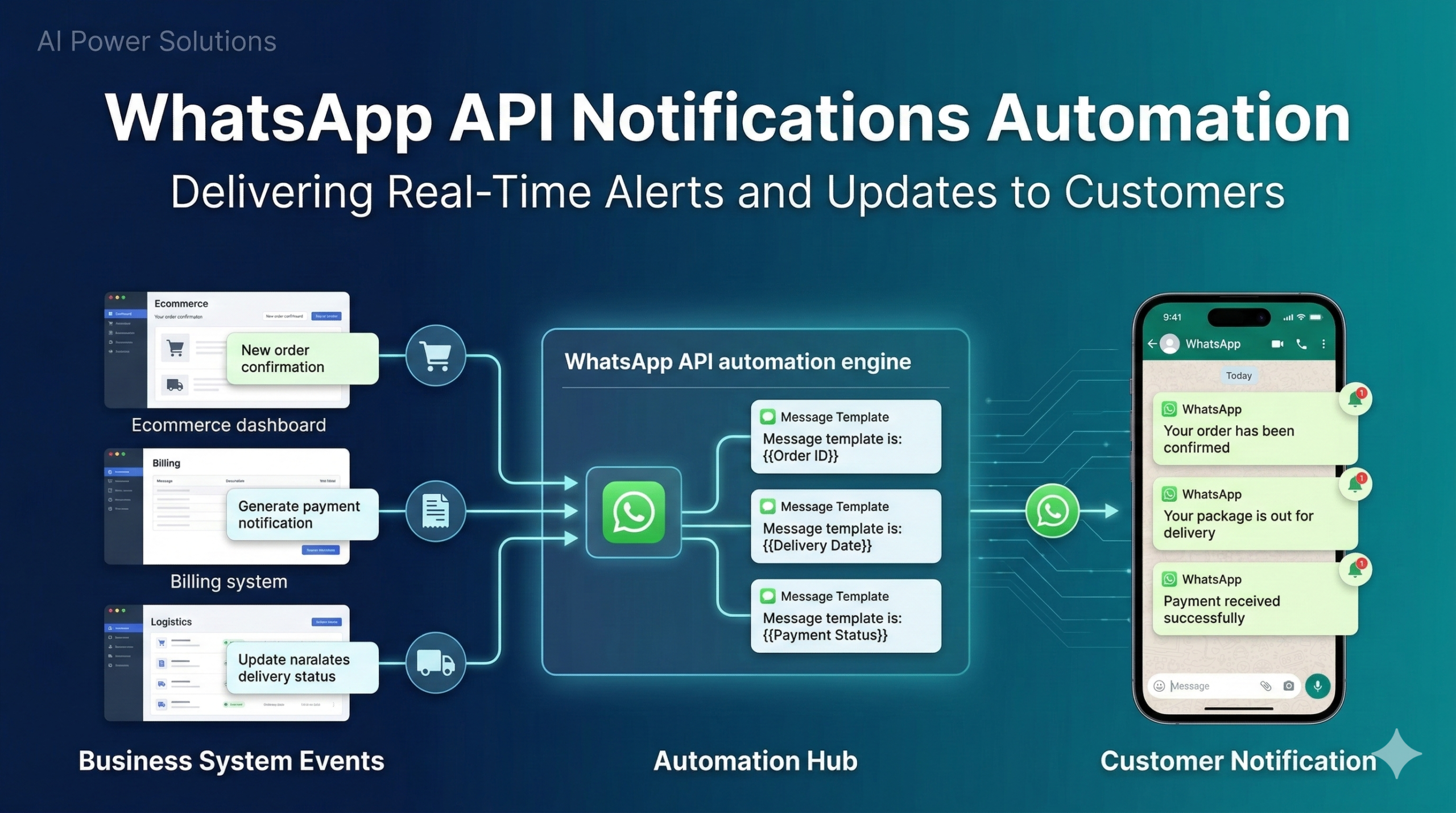
WhatsApp API notifications automation enables businesses to deliver critical updates instantly through customers’ preferred messaging channel. Rather than relying on email inboxes that go unchecked or SMS that limits formatting and interactivity, companies now trigger automated WhatsApp messages for order updates, payment confirmations, security alerts, and service notifications. Backend systems handle delivery logic, compliance rules, and response management while maintaining complete conversation records.
This infrastructure transforms one-way announcements into structured communication systems that operate at enterprise scale across industries and regions, replacing fragmented notification strategies with reliable, trackable messaging workflows.
The Critical Need for Real-Time Customer Communication
Modern digital businesses depend on timely communication to maintain operations and customer trust. Ecommerce platforms must confirm orders and track shipments. SaaS companies need to alert users about service interruptions or feature releases. Financial services require instant fraud detection notifications. Healthcare providers send appointment reminders and test results.
Traditional channels struggle with these requirements. Email delivery remains unreliable for urgent matters-customers might not check inboxes during critical windows. SMS supports basic text but lacks rich formatting, buttons, or document sharing. Push notifications require app downloads and often get ignored amid dozens of other alerts.
WhatsApp API notifications automation addresses these gaps systematically. Customers receive important updates through their most active communication channel while businesses gain delivery receipts, response tracking, and conversation continuity. A single shipping delay notification becomes a complete interaction thread where customers can ask questions, request changes, or confirm receipt.
Why Messaging Platforms Excel for Business Notifications
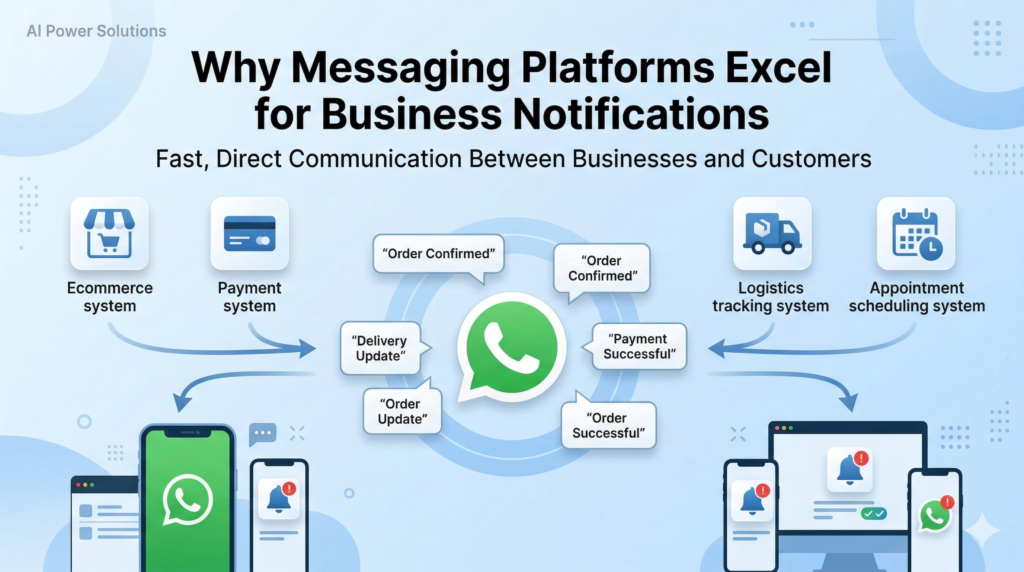
Global communication patterns favor messaging over legacy channels. Customers maintain WhatsApp alongside personal conversations, checking it far more frequently than email. Mobile devices dominate commerce and service interactions-customers expect to receive and respond to updates from smartphones during daily activities.
Messaging offers native advantages for notifications. Rich media support enables order tracking maps, invoice PDFs, and promotional carousels within single messages. Interactive buttons let customers tap “Track Order,” “View Invoice,” or “Reschedule” without leaving the conversation. Persistent threads maintain context-customers reference previous notifications easily while businesses track complete interaction history.
Unlike email’s formal tone or SMS’s character limitations, WhatsApp notifications feel conversational yet professional. A shipping update reads naturally: “Your order #1234 ships tomorrow. Track here: [button]. Expected delivery: March 15th.” Customers engage more readily because the format matches their daily communication habits.
Delivery guarantees also improve dramatically. WhatsApp’s end-to-end encryption ensures messages arrive securely while read receipts provide concrete engagement metrics. Businesses eliminate “did they receive it?” uncertainty that plagues email campaigns.
Enterprise Notification Capabilities of WhatsApp Business API
The Official WhatsApp Business API creates robust notification infrastructure beyond consumer messaging limitations. Consumer WhatsApp suits personal use. Enterprise notification systems require server-side reliability, system integrations, compliance controls, and delivery analytics.
Core notification features include automated template message delivery triggered by backend events, interactive formats supporting buttons and lists for customer actions, comprehensive delivery/read receipts for performance tracking, and system-triggered alerts firing independently of customer-initiated conversations. Multi-user access enables marketing, support, and operations teams to coordinate notifications through shared infrastructure.
Deep platform integrations connect WhatsApp directly to ecommerce, CRM, billing, and logistics systems. An order status change in Shopify instantly triggers a WhatsApp shipment notification. Stripe payment confirmation creates corresponding customer alerts. Zendesk ticket resolution generates proactive status updates. This event-driven architecture ensures notifications always reflect current system reality.
Complete Notification System Architecture
WhatsApp API notifications automation follows predictable event-driven workflows. Backend systems detect trigger events-order fulfillment, payment processing, appointment timing, security incidents, subscription renewals. These events activate notification workflows through API connections or middleware platforms.
The system selects appropriate message templates based on event type, customer segment, language preference, and time zone. Templates populate dynamically with real data-order numbers, tracking links, amounts due, delivery ETAs. WhatsApp’s messaging infrastructure handles delivery through the Official API while capturing comprehensive delivery, read, and response metrics.
Customer replies restart 24-hour service windows enabling free-form responses. Automation platforms capture these interactions, route complex queries to agents, or trigger follow-up workflows. Complete conversation records sync back to originating systems creating unified customer communication histories across touchpoints.
Webhooks provide bidirectional communication. WhatsApp delivery events update ecommerce order statuses. Customer “track package” replies trigger logistics API calls returning real-time location data. This closed-loop automation creates intelligent notification systems that evolve through customer interactions.
Essential Notification Workflows Across Business Functions
Order and shipping notifications form ecommerce notification cores. Order confirmation messages detail contents, expected fulfillment, and estimated delivery while providing order tracking links. Shipment notifications include carrier details, tracking numbers, and real-time maps. Delivery confirmations prompt feedback and upsell related products. Returns initiate through reply buttons triggering RMA processes.
Payment notifications maintain financial transparency. Invoice messages contain amounts due, due dates, and one-click payment links. Receipt confirmations detail transaction information and next billing dates. Failed payment alerts offer resolution steps while grace period reminders prevent service interruptions. Recurring billing updates clarify plan changes and renewal dates.
Appointment reminders reduce no-shows dramatically. Forty-eight hour notifications provide complete logistical details. Twenty-four hour confirmations request reply verification. Two-hour final alerts ensure customers prepare appropriately. Cancellations and rescheduling flow through self-service reply options maintaining calendar accuracy.
Account security alerts protect customer trust. New device login notifications prompt verification. Password change confirmations provide audit trails. Suspicious activity alerts enable rapid response. Two-factor authentication codes deliver securely through encrypted channels.
Subscription management notifications drive retention. Renewal reminders detail upcoming charges and cancellation options. Plan upgrade prompts highlight new features. Usage limit warnings prevent service disruptions. Churn prevention messages offer win-back incentives to lapsed accounts.
Each workflow improves specific business outcomes while maintaining conversational continuity customers expect from WhatsApp.
System Integrations That Power Reliable Notifications
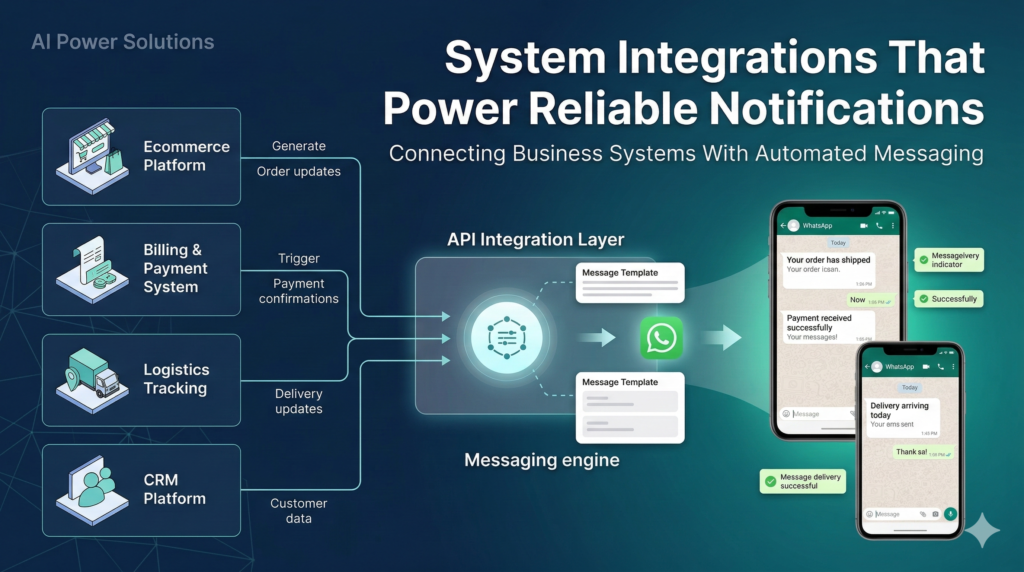
Effective WhatsApp API notifications automation requires deep platform connections. Ecommerce platforms like Shopify and WooCommerce trigger order notifications automatically when fulfillment status changes. Inventory updates generate restock alerts. Cart abandonment flows initiate through integrated recovery sequences.
CRM systems including HubSpot, Salesforce, and Zoho connect customer lifecycle events to WhatsApp delivery. Lead nurturing campaigns, deal progression alerts, and customer success check-ins flow naturally through messaging channels. Complete interaction histories enrich customer profiles for personalized future communications.
Billing platforms including Stripe, Chargebee, and Recurly generate invoice, receipt, and payment failure notifications. Subscription tier changes, upcoming renewals, and usage-based billing summaries maintain billing transparency while reducing support inquiries about payment status.
Logistics integrations pull real-time tracking from carriers including FedEx, DHL, and UPS. Package location updates, customs clearance notifications, and delivery exceptions keep customers informed proactively. Multi-carrier support handles complex international shipping scenarios.
SaaS platforms connect product events to customer notifications. Feature releases, security patches, service interruptions, and usage milestones communicate directly through customers’ active communication channel rather than buried email digests.
AIPowerSolutions.in specializes in these WhatsApp API notification integrations, creating event-driven messaging infrastructure that maintains synchronization across complex business systems.
WhatsApp Template Messaging and Compliance Framework
Business-initiated notifications outside active 24-hour conversations require pre-approved message templates. WhatsApp categorizes these as utility, authentication, or marketing based on content purpose and customer value.
Utility templates handle transactional notifications including order updates, shipment tracking, appointment reminders, and service alerts. These templates support variables for personalization-order numbers, tracking URLs, delivery ETAs, appointment details-while maintaining approved structure.
Authentication templates deliver one-time passwords, login verifications, and security confirmations. Strict formatting ensures codes cannot be intercepted while maintaining delivery speed critical for time-sensitive authentication flows.
Marketing templates promote offers, feature updates, and re-engagement campaigns. Higher scrutiny requires clear customer value and opt-in compliance. Overuse risks deliverability issues and customer fatigue.
24-hour service window rules permit free-form replies during active conversations. Customer responses restart conversation timers enabling natural support interactions. Template notifications maintain communication outside these windows while respecting frequency limits.
Template approval processes verify compliance, prevent spam, and ensure quality. Businesses maintain template libraries covering common scenarios while establishing governance around new template creation and approval workflows.
Principles of Effective Notification Design
Conciseness drives engagement. Notifications work best at 100-160 characters conveying essential information with clear next steps. “Order #1234 ships tomorrow. Track package: [Track button]. Delivery: Mar 15.” outperforms lengthy explanations customers won’t read.
Actionable content converts. Every notification should enable specific outcomes. Order updates include tracking buttons. Payment alerts contain one-click payment links. Appointment reminders offer reschedule options. Clear calls-to-action guide customer behavior effectively.
Context maintains relevance. Reference previous interactions and customer state. “Following your recent purchase (#1234), your order ships today” feels continuous rather than generic blasting. Personalization through first names, recent activity, and account context builds familiarity.
Timing respects customer routines. Morning shipment updates, afternoon appointment reminders, evening payment notifications align with daily patterns. Time zone awareness prevents 3 AM delivery alerts. Frequency caps prevent notification fatigue.
Opt-out compliance builds trust. Every template includes clear STOP instructions. Respecting preferences maintains deliverability and customer goodwill. Transparent communication about notification purposes during onboarding sets proper expectations.
Operational Impact of Notification Automation
Communication velocity accelerates dramatically. WhatsApp notifications achieve 90-98% open rates within minutes versus email’s 20-30% over hours. Urgent information reaches customers during decision windows rather than buried in crowded inboxes.
Customer experience elevates through reliability. Guaranteed delivery, rich interactive content, and conversational continuity create superior notification experiences. Customers trust they’ll receive important updates through their active communication channel.
Support volume decreases significantly. Proactive order tracking eliminates “where is my package” inquiries. Appointment reminders reduce rescheduling confusion. Payment confirmations prevent billing disputes. Self-service reply options resolve simple issues without agent intervention.
Operational efficiency improves across functions. Marketing coordinates campaigns through unified infrastructure. Support accesses complete conversation context. Operations maintains real-time visibility into customer notifications. Single systems replace siloed communication tools.
Data richness enhances decision making. Complete delivery/read receipts, reply patterns, and engagement metrics feed analytics platforms. Notification performance informs campaign optimization, timing strategies, and channel allocation decisions.
Avoiding Notification System Pitfalls
Frequency overload alienates customers. Sending daily status updates annoys rather than informs. Prioritize genuinely valuable notifications and respect customer feedback. Smart throttling prevents fatigue while maintaining essential communication.
Poor template design reduces effectiveness. Generic messages without clear actions or context fail to engage. Test templates rigorously before scaling. Maintain approval compliance while iterating based on reply patterns and engagement data.
Missing integrations create data silos. Notifications sent without system context confuse customers and operations teams. Order alerts referencing wrong tracking numbers erode trust. Complete backend synchronization ensures messaging accuracy.
Ignoring compliance risks deliverability. Unapproved templates, excessive frequency, or missing opt-out language trigger platform restrictions. Establish governance processes around template management, frequency caps, and customer consent tracking.
Lack of response handling wastes opportunities. Customers replying to notifications expect conversation continuity. Unmonitored replies create frustration. Route responses intelligently to appropriate teams or automated workflows based on intent and urgency.
Future Directions in Notification Automation
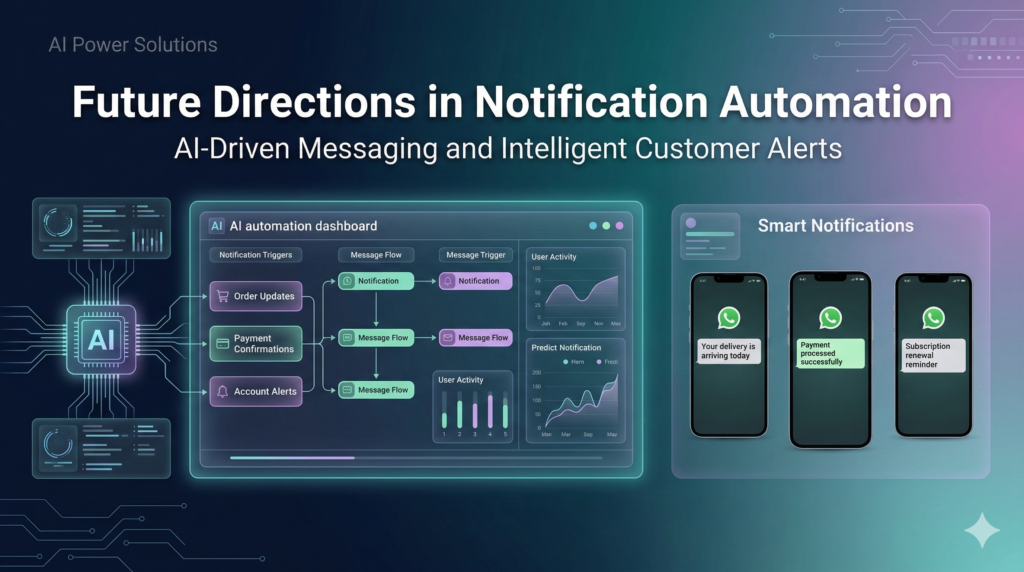
AI-driven personalization will analyze customer behavior, preferences, and interaction history to deliver contextually perfect notifications. “Based on your frequent Tuesday deliveries, expect shipment tomorrow 2-4 PM” feels genuinely helpful rather than templated spam.
Conversational notifications expand beyond one-way alerts. Customers tap “track now” buttons receiving live updates. “Reschedule delivery?” prompts reveal alternative windows instantly. Two-way interaction creates richer engagement while maintaining automation efficiency.
Commerce integration embeds payments, product actions, and loyalty rewards directly in notifications. Post-delivery “loved your order?” messages prompt reviews and related purchases. Payment reminders include one-click settlement options.
Unified messaging platforms coordinate WhatsApp, SMS fallback, email, and push across single workflows. Channel preference, deliverability data, and customer state determine optimal delivery path while maintaining consistent messaging.
Predictive notifications leverage usage patterns and external data to preempt issues. “Your subscription renews tomorrow-notice slower performance? Upgrade now” prevents churn proactively. Weather-aware delivery adjustments inform customers before delays occur.
Strategic Conclusion
WhatsApp API notifications automation creates reliable messaging infrastructure for modern digital businesses. Event-driven workflows connect backend systems to customers’ active communication channel, delivering essential updates with guaranteed reach and measurable engagement.
Well-designed notification systems reduce support volume, accelerate communication velocity, and create richer customer data for analytics and personalization. Compliance frameworks, integration architecture, and response handling transform one-way announcements into bidirectional relationship tools.
Fragmented email blasts and unreliable SMS become relics as businesses adopt structured WhatsApp notification infrastructure. Marketing, operations, support, and finance coordinate through unified messaging systems rather than competing channel strategies.
AIPowerSolutions.in implements WhatsApp API notifications automation and system integrations, helping businesses build scalable messaging infrastructure that maintains customer relationships while streamlining critical communication workflows across global operations.
Related: Read our complete WhatsApp Business API setup guide or browse our WhatsApp marketing tools.